How to Sell Cards on Whatnot: 2026 Seller Guide
Selling cards on Whatnot is the most direct path to price discovery and volume in the collectibles market. Trading cards are consistently Whatnot's highest-GMV category — and for sellers who know the format, the live auction model drives realized prices 10–20% above eBay comps on graded and high-demand cards. The key is understanding show structure, category selection, and the audience-building mechanics that separate $500-per-show sellers from $5,000-per-show shows.
- How to sell cards on Whatnot comes down to four decisions: niche, show format, card grading strategy, and scheduling consistency
- WNBA cards grew +1,670% on Whatnot in 2025 — 3x faster than NBA — making women's sports cards the clearest asymmetric opportunity in 2026
- Graded cards (PSA, BGS) command 2–5x raw card prices on Whatnot — but the math only works for cards with $75+ raw market value
- Fixed weekly show schedules build appointment viewers; random scheduling keeps you stuck at single-digit viewers indefinitely
- A $200–$400 streaming setup is sufficient to look professional from your first show — lighting matters more than camera quality
Why Whatnot Is the Best Place to Sell Cards Right Now
The structural advantage Whatnot has over every other selling platform is timing. A card listed on eBay sits for 7 days. The same card on Whatnot can be in a buyer's hands within 10 minutes of opening the box. For sellers who want to move volume, match collectors with specific inventory, and build a repeat customer base, there is no better-matched platform in the market today.
The live auction format creates real-time price competition. When two or more collectors both want the same Caitlin Clark rookie auto or a PSA 10 Charizard, the bidding drives prices above what either would have paid passively on a BIN listing. Whatnot sellers consistently see graded and high-demand cards realize 10–20% above eBay comps in competitive sessions — not because buyers are irrational, but because the live format eliminates the waiting game that suppresses BIN offers.
The fee structure is also genuinely competitive. Whatnot charges 8% in seller fees plus payment processing. eBay's combined take — final value fees plus payment processing — runs 12.9% plus additional charges that push total fees toward 14–15% for most card sellers. That 5–7 point difference compounds significantly at scale. A seller moving $10,000 per month in cards saves $500–$700 monthly in platform fees alone by operating on Whatnot versus eBay.
Understanding Whatnot's full fee structure and profit margins before scaling matters — the platform economics are favorable, but knowing exactly where your margins sit at different price points shapes which cards are worth acquiring for live sale versus holding or selling elsewhere.
Choosing Your Card Niche: Sports, TCG, Pokemon, or Women's Sports
The first decision new card sellers on Whatnot get wrong is trying to cover too many categories at once. Buyers on Whatnot follow sellers, not products — and they follow sellers who clearly specialize in something. A show that rotates between Pokemon, NFL, NBA, and baseball in a single session confuses the algorithm and the audience. Pick one primary category and build credibility there before expanding.
| Category | Audience Size | Avg. Transaction Value | Competition Level | 2026 Trend |
|---|---|---|---|---|
| Pokémon / TCG | Very Large | $15–$80 per card | High | Stable, strong floor |
| NBA Sports Cards | Large | $25–$200+ | High | Moderate growth |
| NFL Sports Cards | Large | $20–$150+ | High | Stable |
| MLB Sports Cards | Medium | $20–$300+ | Medium | Growing |
| WNBA Sports Cards | Fast-Growing | $10–$500+ | Low–Medium | +1,670% in 2025 |
| Soccer / International | Niche | $15–$100 | Low | Emerging |
If you are starting cold with no established audience and limited inventory budget, WNBA and women's sports cards represent the clearest asymmetric opportunity heading into 2026. The buyer pool is growing faster than the seller supply, which means earlier movers capture audience and inventory advantages that become expensive to replicate once the category saturates.
The WNBA Card Opportunity: Why 2026 Is Still Early
WNBA trading cards grew +1,670% on Whatnot in 2025, outpacing NBA card growth by roughly 3x over the same period. That is not a spike driven by a single player or a single product drop — it is a structural category shift. Expanded media deals, Caitlin Clark's sustained cultural presence heading into her second season, and a new generation of collectors entering through women's sports have created a demand curve that is still in its early acceleration phase.
The 2026 window matters for one specific reason: category saturation on Whatnot follows a predictable arc. Sellers who establish a consistent show in an emerging category before it peaks build audience relationships and inventory sourcing connections that are expensive to replicate once everyone arrives. WNBA card specialists on Whatnot today face a fraction of the competition that Pokemon sellers or NBA sellers face — with a buyer pool growing faster than either of those established categories.
The practical entry point is Topps WNBA, Panini Prizm WNBA, and Panini Immaculate WNBA — these are the primary licensed products with the most liquid secondary market. Rookie auto cards and numbered parallels from top WNBA players are commanding premiums that mirror early NBA rookie auto markets from 2019–2021. A PSA 10 Caitlin Clark Prizm rookie auto that sold for $200 in 2025 has comparable trajectory potential to Zion Williamson Prizm autos from his first season — driven by the same combination of crossover cultural appeal and limited print runs.
Show Structure: Breaks, Singles, Lots, and What Performs Best
The format of your Whatnot show determines your revenue ceiling more than the actual inventory you carry. There are three main show structures, and each serves a different goal:
Box and case breaks are the highest-energy, highest-risk format. You open sealed product live, and spots are sold in advance by team or randomized. Break shows can generate $500–$5,000 per session for established sellers, but they require real capital tied up in sealed product, and a poor box result — five base cards and no hits — can damage your reputation with buyers who feel they received bad value. Breaks work best for sellers who have consistent sealed product sourcing at wholesale and an established viewer base who understands the inherent variance.
Single card auctions are the most accessible format for new sellers. You list individual cards one at a time, starting at a floor price — typically $1 or the minimum you'd accept. The auction mechanic creates competition and drives prices above what most sellers expect from comparable BIN listings. Single auctions work best for graded cards, vintage cards, and rookie autos: any card where scarcity and condition are clearly visible on camera. This format also gives you real-time market feedback on exactly which players, sets, and conditions the market wants right now.
Lots and bulk are the volume play. Bundling mid-value cards into themed lots — all Luka Doncic, all Prizm base rookies, all PSA-slabbed graded cards under $50 — moves inventory quickly and gives buyers the sense of discovery. Lots typically convert well as a show closer after high-value singles have moved, giving buyers who didn't win earlier auctions a way to leave with something.
Our recommendation for new sellers: start with single card auctions for your first 10–15 shows. The format is low-pressure, teaches you the auction cadence and buyer interaction style, and lets you learn price discovery without committing capital to sealed product you may not be able to source consistently.
Graded vs. Raw Cards: Pricing Strategy and When to Grade
Graded cards — slabbed by PSA, BGS, or SGC — command a structural premium on Whatnot. A raw rookie card and its graded counterpart from the same print run can differ by 2–5x in realized price, depending on the player, set, and grade. The grade is not just a condition stamp; it is a trust signal that removes friction for buyers who cannot physically inspect the card. On a live streaming platform where buyers are making purchase decisions from a camera feed, that trust premium is amplified.
That said, grading every card is one of the most common and costly mistakes new Whatnot sellers make. The math only works at specific card values:
- Raw card estimated value under $30: Grading costs ($15–$30 per card at bulk PSA rates, plus shipping and wait time) eliminate your margin entirely. Sell raw or bundle into lots.
- Raw card estimated value $30–$75: Grade selectively based on condition confidence. Near-mint cards with visible centering issues or surface wear should not be submitted — a PSA 8 on a $50 card rarely recovers your grading cost.
- Raw card estimated value $75+: Submit for grading. A PSA 10 on a card at this price point typically returns 2–4x the ungraded market price. The math works clearly.
Turnaround time matters for cash flow planning. At standard PSA rates in 2026, bulk submissions take 60–90 days. Factor that holding period before committing large batches. Also factor that grade results are uncertain — budgeting for a mix of PSA 9s and PSA 10s, with occasional PSA 8s, is more realistic than planning around all-10 outcomes. The timing of your show schedule relative to grading return windows affects which inventory you can feature when.
Building Your Whatnot Audience: From First Show to Regular Viewers
The Whatnot algorithm rewards consistency — specifically, show frequency and viewer retention within sessions. A seller who runs one show per week at the same day and time will outgrow an equally talented seller who shows up randomly, consistently. The platform's discovery mechanics favor shows that maintain scheduled cadences because those shows have predictable viewership, which Whatnot can promote to its notification-subscribed buyer base.
Scheduling regularity creates appointment viewers. Set a day and time for your show — Sunday at 7 PM ET, Wednesday at 8 PM ET — and stick to it for at least 90 days. Buyers who enjoyed your previous show set reminders. Random scheduling means you start from zero reach every session, with no expectation-setting and no notification leverage.
Cross-promotion within the card community. Whatnot's card community has active Discord servers, Twitter and X communities, and Reddit threads where sellers cross-promote shows. A few follow-for-follow partnerships with sellers in adjacent niches — you specialize in WNBA, they specialize in NBA — can add 50–200 followers per week in the early stages without paid promotion.
In-show interaction drives algorithmic reach. The Whatnot algorithm tracks session watch time and viewer engagement, not just unique viewers. Sellers who talk to their audience, answer questions in chat, call out usernames, and tell the story behind specific cards see dramatically longer average watch times — which translates directly into broader algorithm-driven reach. In our experience working with Whatnot sellers, active chat engagement can increase average session length by 40–60%, which compounds into significantly more discovery placements over time.
Post-show follow-up converts one-time buyers into regulars. If a buyer purchases in your show and has a positive experience, there is a 60–70% chance they return for your next session if you message them a show reminder within 48 hours. Use Whatnot's built-in messaging to send a brief, personal follow-up to every first-time buyer. One message. Not a broadcast — something that acknowledges the specific card they won.
Equipment, Lighting, and Setup for a Professional Card Show
You do not need a $3,000 setup to look professional. But you do need adequate lighting and a stable card display, because buyers make buy-or-pass decisions in seconds based on what they can see on screen. Poor lighting and shaky card presentation signal low trust, which directly suppresses bidding.
Minimum viable setup ($200–$400 total):
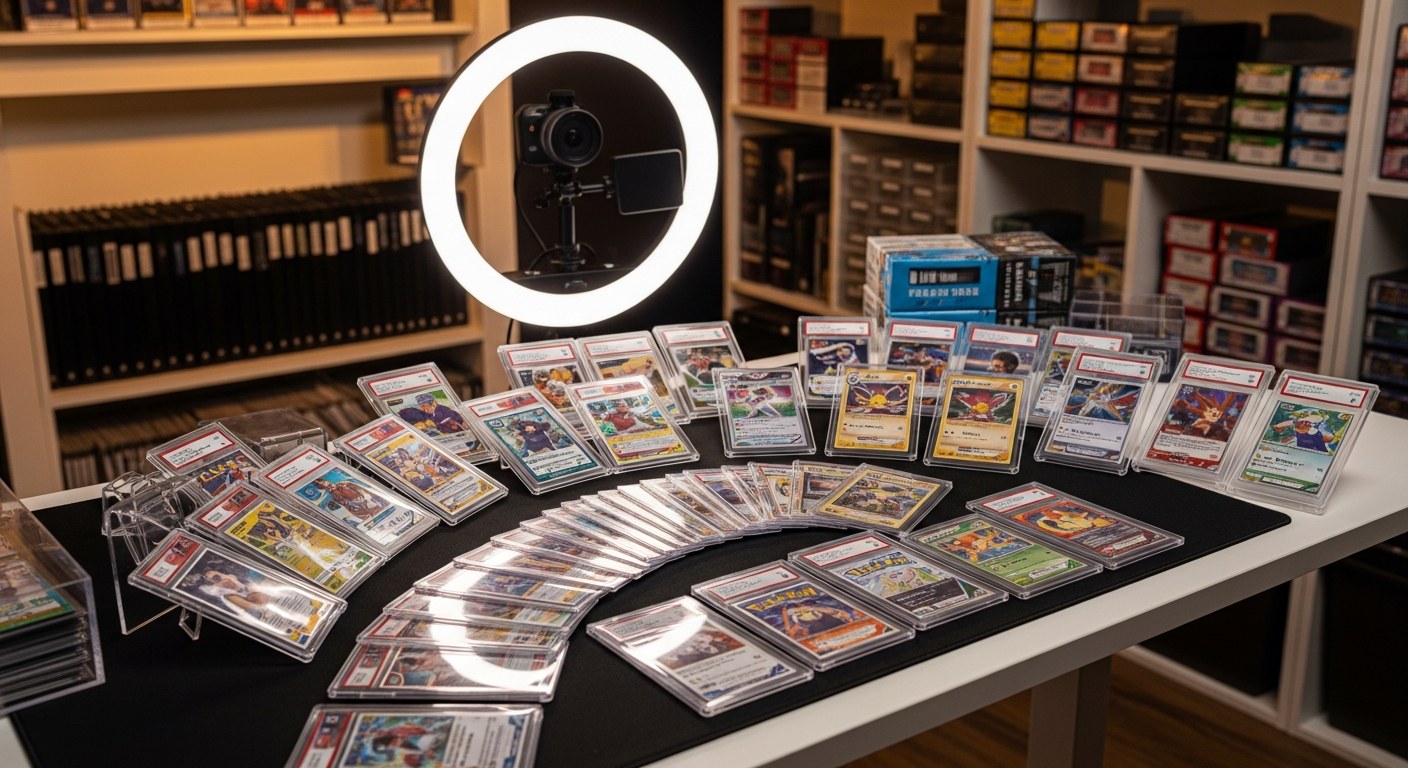
- Ring light or softbox: A $40–$80 LED ring light eliminates the shadowed, grainy look that kills buyer confidence. This is the single highest-leverage equipment investment for a new Whatnot seller.
- Card display stands: Transparent acrylic card stands ($15–$30 for a set) show cards upright, face-forward, and eliminate the fumbling that makes amateur shows feel chaotic. Buyers need to see the card clearly, quickly.
- Phone mount or tripod: Your phone camera is more than sufficient for Whatnot's streaming quality. A flexible tripod with a phone clamp ($25–$40) keeps your framing stable and your hands free to handle cards and interact with chat.
- Clean background: A solid dark backdrop or a clean desk with minimal visual noise is enough. Buyers focus on cards, not backgrounds.
Upgrades that pay off after 30+ shows: A dedicated second device for monitoring your own stream and managing chat simultaneously; a label printer for rapid lot pricing; card scanner integration for real-time inventory verification mid-show. These investments reduce the operational friction that slows down high-volume sessions.
The visual identity of your show — thumbnail design, overlay graphics, consistent logo placement — matters more at 60+ shows than at 10. That is where investing in professional creative strategy pays off: a brand that looks intentional on camera keeps buyers in session longer and commands better prices on equivalent inventory.
How Atlas Helps Whatnot Card Sellers Build a Brand That Grows
Most Whatnot card sellers think about inventory first and brand second. The sellers who build sustainable shows with consistent revenue flip that order. Your show name, visual identity, thumbnail style, and the consistent on-camera presentation of your cards across every session are what turn a one-time viewer into a regular — and regulars are the engine of Whatnot growth.
Our team at Atlas builds brand identities and creative systems for Whatnot sellers at every stage. From show overlays and thumbnail templates to full channel strategy, we've worked with sellers across sports cards, Pokemon, and collectibles categories. The pattern is consistent: sellers who invest in brand presentation in their first 60 days build audiences 3–4x faster than those who treat visual identity as an afterthought.
We also work with sellers on off-platform content strategy — the social content on Instagram, TikTok, and Twitter that drives new followers into your Whatnot show before they've ever watched a session live. The compounding effect of a recognizable brand across platforms is where long-term growth comes from. If you're serious about building a card show that generates consistent revenue, our Whatnot branding and strategy team is the fastest path to a professional presence that grows.
Frequently Asked Questions
How much does it cost to start selling cards on Whatnot?
You can start selling cards on Whatnot for under $500 in total startup costs — assuming you have existing card inventory. The platform itself is free to join; Whatnot charges 8% seller fees plus payment processing on completed transactions. A basic streaming setup (ring light, phone mount, card stands) runs $150–$250. Your real cost is inventory: most sellers start with $200–$500 in cards they already own or can source at local shows and card shops, then reinvest early profits to build stock. The capital threshold to run a profitable first show is lower than most new sellers expect.
Do I need a business license to sell cards on Whatnot?
Whatnot requires sellers to complete a W-9 and reports earnings above $600 to the IRS, which means selling cards at meaningful volume is a taxable activity regardless of how you structure it. Many established Whatnot card sellers operate as sole proprietors or single-member LLCs. If you expect to gross more than $10,000 per year through card sales, consulting a tax professional about entity structure and sales tax obligations in your state is worth the $200–$300 it typically costs. Operating as a recognized business also makes it easier to open wholesale accounts with card distributors and buy sealed product below retail.
What types of cards sell best on Whatnot?
Modern sports card rookies — especially first-year Prizm, Optic, and Select products — consistently perform well on Whatnot because buyers can see exactly what they are getting and condition grades are easy to verify on camera. Graded cards (PSA, BGS) outsell equivalent raw cards at higher margins due to the trust premium the slab provides in a live selling environment. In the TCG space, graded Pokemon from the base set through the neo era and sealed vintage product drive strong competitive bidding. In 2026, WNBA rookie cards — particularly auto and numbered parallels from Topps and Panini products — are the emerging high-upside category, with buyer pool growth of 1,670% on the platform in 2025.
How long does it take to grow an audience on Whatnot?
Most sellers who commit to weekly shows see meaningful audience traction within 60–90 days — defined as 30 or more regular viewers who show up consistently to their scheduled sessions. The sellers who reach this milestone fastest combine three behaviors: fixed schedule consistency, active in-show chat engagement, and off-platform promotion through Twitter, Instagram, and card community Discord servers. Sellers who show up randomly and do not promote outside the platform often stall at 5–15 viewers per session indefinitely, regardless of how strong their inventory is. The algorithm rewards predictability.
Is it worth grading cards before selling on Whatnot?
For cards with a raw market value above $75, grading almost always increases the realized price on Whatnot by more than the cost of the submission. PSA 10s on modern rookie cards can trade at 3–5x the price of equivalent ungraded copies, particularly for in-demand players. Below $30 raw value, grading costs eliminate your margin — sell raw or bundle into lots. The $30–$75 range requires case-by-case judgment based on the specific card and your confidence in its grade potential. A practical rule: if you would not pay to insure the card during shipping, it probably isn't worth grading.