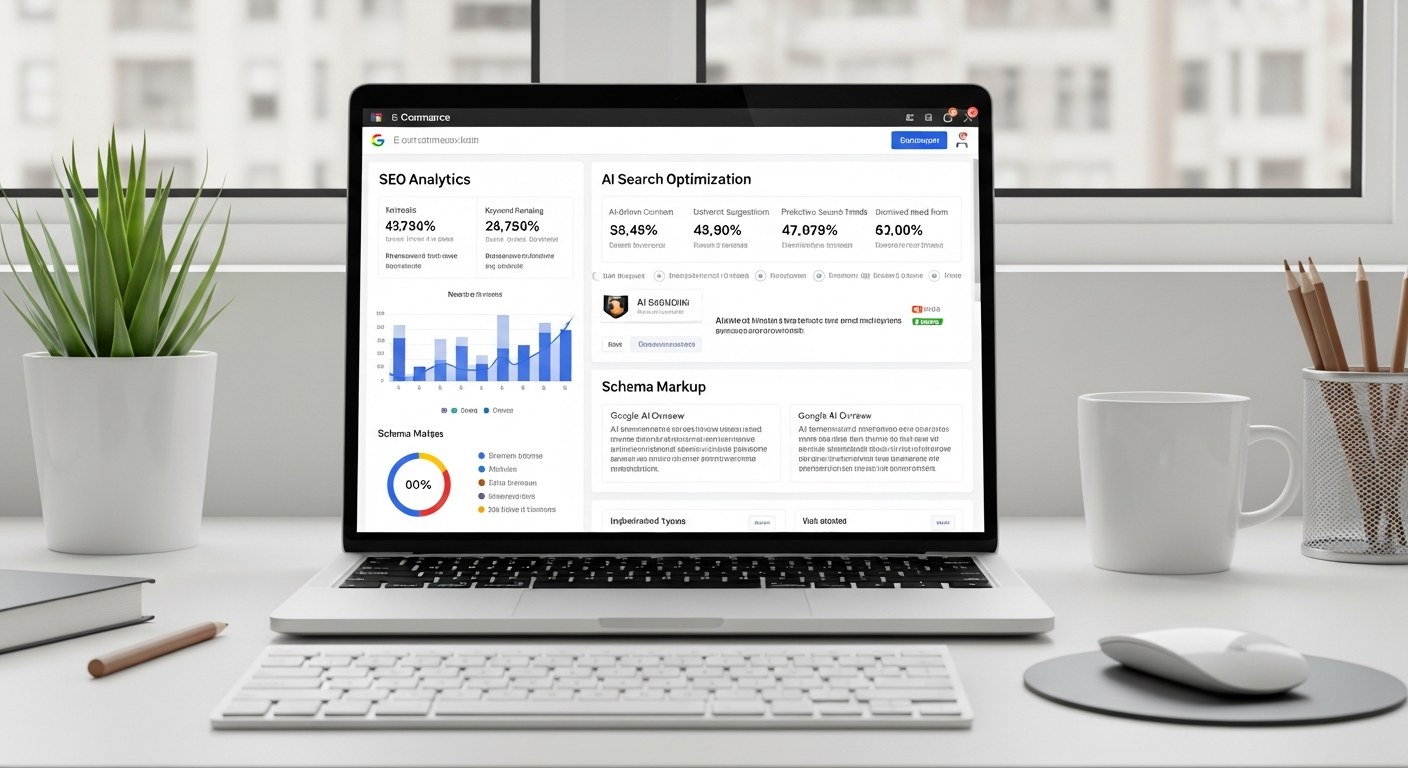
Shopify SEO generative engine optimization 2026 is no longer the same discipline it was two years ago. Google AI Overviews now appear on a significant share of shopping queries, ChatGPT Shopping handles product research for millions of users daily, and Perplexity routes purchase-intent queries toward brands it trusts — often without the consumer ever performing a traditional search. The Shopify stores getting discovered, cited, and recommended are not necessarily the ones with the highest domain authority. They're the ones whose data, content, and schema are structured for machine reasoning.
- Google AI Overviews now appear on shopping queries — keyword-first SEO alone is no longer sufficient
- Generative Engine Optimization (GEO) is a distinct discipline: it optimizes for AI citation, not just blue-link rankings
- Products with complete schema markup are 3× more likely to appear in AI-generated recommendations (RepeatDigital / GlobeRunner, 2026) — see our ecommerce product page schema markup playbook for the full implementation guide
- Direct-answer content, FAQPage schema, and E-E-A-T signals are the core GEO levers for Shopify stores
- Google Analytics 4 added an "AI Assistant" channel in 2026 — AI search referral is now measurable traffic
- What Is GEO and Why It Matters for Shopify
- How AI Search Systems Evaluate and Recommend Products
- Schema Markup for Shopify: The GEO Foundation
- Content That AI Cites: What to Write and How to Structure It
- E-E-A-T Signals in 2026: Building the Trust AI Systems Look For
- Measuring Your GEO Performance: The New Metrics That Matter
- Traditional SEO Still Matters: What Doesn't Change
- How Atlas Optimizes Shopify Stores for AI Search Visibility
- FAQ
What Is Generative Engine Optimization (GEO) and Why It Matters for Shopify
Generative Engine Optimization is the practice of making your Shopify store a source that AI search systems trust, extract from, and cite in their generated answers. Where traditional SEO asks: "Does this page rank for this keyword?" — GEO asks: "Does this page get cited when an AI system answers a shopping question in my category?"
The distinction matters because the mechanics are different. Traditional search ranking relies primarily on link authority, keyword relevance, and click-through signals. AI citation relies on content structure, schema completeness, answer extractability, and off-site credibility — a different optimization surface entirely.
The scale of the shift is real. E-commerce brands with optimized schema markup see significantly higher click-through rates via rich results — price, availability, and star ratings shown directly in search (Shopify, 2026). Google Analytics 4 added an "AI Assistant" channel in 2026 to track referral traffic from ChatGPT, Gemini, and Claude — indicating AI search referral is now a measurable, material traffic source for brands appearing in AI answers.
For Shopify merchants, this creates both urgency and opportunity. Most competitors haven't adapted their SEO strategy beyond surface-level adjustments. The brands that build GEO infrastructure now — before AI-mediated shopping becomes the default — will be systematically harder to displace.
How AI Search Systems Evaluate and Recommend Products
AI search systems don't evaluate pages the way traditional crawlers do. They're not counting keyword density or analyzing anchor text ratios. They're asking: "Is this source trustworthy, extractable, and sufficiently specific to answer the user's question?"
Here's what AI systems actually look at when evaluating Shopify product and brand pages:
Schema completeness. Products with complete schema markup are three times more likely to appear in AI-generated product recommendations (RepeatDigital / GlobeRunner, 2026). "Complete" means not just Product schema with a price — it means price, availability, description, image, brand, and ideally AggregateRating once you have sufficient review volume. Incomplete schema creates an invisible barrier between your product and AI recommendation visibility.
Direct-answer content structure. AI systems extract answers from pages — they don't present pages wholesale. A paragraph that opens with a direct, specific answer to a user's question is far more likely to be cited than a paragraph that builds context before arriving at the point. This is a structural shift, not a stylistic one.
E-E-A-T signals. Experience, Expertise, Authoritativeness, and Trustworthiness signals tell AI systems whether a source is credible enough to cite. For Shopify stores, this means: detailed About pages, visible author credentials on blog content, verifiable business information (address, phone, reviews), and references from credible third-party sources.
Off-site presence. AI training data and real-time retrieval both pull from sources beyond your own website. Review platforms (Google Business, Trustpilot, industry-specific review sites), forum discussions (Reddit, niche communities), and third-party editorial mentions all contribute to an AI system's trust model for your brand.
Schema Markup for Shopify: The GEO Foundation
Schema markup is the single highest-leverage technical change most Shopify stores can make for GEO performance. It's also the most commonly incomplete. Here's what complete schema coverage looks like for a Shopify store optimized for AI search:
| Schema Type | Where to Implement | Key Fields | GEO Impact |
|---|---|---|---|
| Product | All product pages | name, image, description, offers (price, availability, currency), brand | Required for AI product recommendations and Google Shopping |
| AggregateRating | Product pages (10+ reviews) | ratingValue, reviewCount | Star ratings in search; strong AI trust signal |
| Organization | Homepage | name, url, logo, contactPoint, sameAs (social profiles) | Entity clarity; foundational brand trust for AI systems |
| FAQPage | Blog posts, collection pages | Question + Answer pairs (standalone paragraphs) | Primary AI citation format; FAQ answers extracted directly |
| Article | All blog posts | headline, datePublished, author, image | Content freshness signal; AI favors recently published content |
| BreadcrumbList | All pages | Hierarchical page path | Site architecture signal; improves AI understanding of content relationships |
Most Shopify themes auto-generate basic Product schema — but "basic" typically means name and price only. Check your implementation with Google's Rich Results Test. Any field showing as "missing" or "recommended" is leaving AI visibility on the table.
One critical nuance: AggregateRating schema requires a minimum of 10 ratings before Google displays star ratings in search results (Google Search Central, 2026). If your review count is below that threshold, prioritizing a review acquisition strategy — post-purchase email sequences, SMS review requests — directly accelerates your GEO readiness.
Content That AI Cites: What to Write and How to Structure It
Content that AI systems cite has three structural characteristics that distinguish it from content written purely for human readers. Understanding these characteristics changes how you approach blog posts, collection page copy, and product descriptions. For a dedicated playbook on optimizing collection pages specifically, see our guide on ecommerce category page SEO.
Direct-answer opening paragraphs. The very first paragraph after a heading should answer the question that heading poses — completely, without preamble. AI systems extract paragraphs that stand alone as answers. A paragraph that says "This is a complex question with many factors to consider…" before arriving at an answer three sentences later will be skipped in favor of a page that leads with the answer.
H2 headings structured as extractable statements or questions. "What Is Shopify GEO?" is more citation-friendly than "Introduction to GEO." The heading signals the answer scope; the paragraph delivers it. AI systems construct a mapping between queries and page sections — clear, specific H2s make that mapping easier.
FAQ sections with standalone paragraph answers. The FAQ section is the single most reliably cited content format in AI-generated answers. Each answer must be a complete, self-contained paragraph — typically 2–4 sentences that fully address the question without requiring context from elsewhere on the page. Bullet lists and fragments are rarely cited. For context on how GEO fits within a broader Shopify SEO strategy, our Shopify GEO guide covers the foundational principles that apply across store types.
Beyond structure, content depth matters. A single 2,000-word post that thoroughly addresses one specific topic is more citation-worthy than five 400-word posts on related topics. AI systems are calibrated to surface authoritative, comprehensive answers — thin content is ranked below the threshold for citation even when it technically answers the question.
E-E-A-T Signals in 2026: Building the Trust AI Systems Look For
Google's E-E-A-T framework — Experience, Expertise, Authoritativeness, Trustworthiness — was originally a quality rater guideline. In 2026, it's effectively the trust model that AI systems use when deciding whether to cite a source in a generated answer. For Shopify merchants, building E-E-A-T is both a traditional SEO play and a direct GEO input.
Experience signals. Content that demonstrates real-world, first-hand experience with a topic outperforms content that summarizes third-party information. For Shopify brands, this means case study content, specific client or product outcomes with actual numbers, and blog posts written by practitioners with visible credentials. "We've run this for 200+ Shopify stores" is experience. "According to research, brands should…" is not.
Expertise signals. Author credentials, linked professional profiles, and detailed About pages all contribute. AI systems evaluate the credibility of the source producing content, not just the content itself. If your blog posts have no visible author, linking them to named individuals with verifiable expertise is a concrete improvement step.
Authoritativeness signals. These come primarily from off-site sources: editorial links from recognized industry publications, being cited in third-party roundups and comparison guides, appearing as a source in news coverage. Building authoritativeness for a Shopify brand takes time — but even modest editorial presence in industry blogs and podcast appearances contributes to the off-site signal profile that AI systems read.
Trustworthiness signals. Clear business contact information, a transparent return and shipping policy, verifiable customer reviews on Google Business, and SSL/security indicators all contribute. These are table stakes for traditional ecommerce conversion — and they're now GEO inputs as well.
Measuring Your GEO Performance: The New Metrics That Matter
GEO performance requires a different measurement framework than traditional rank tracking. You can rank number one on Google for your target keyword and still be invisible in the AI answers that your customers are actually using for purchase research. Here's the measurement approach that captures both channels.
AI citation auditing (weekly). Manually run category-level and product-specific queries in ChatGPT, Gemini, and Perplexity. Log whether your brand is cited, how it's described, and what sources are attributed. Keep a running log — citation patterns over time are more valuable than any single audit. You'll see which topics your brand owns in AI answers and which your competitors currently dominate.
GA4 AI Assistant channel. Google Analytics 4's new AI Assistant channel tracks referral traffic from ChatGPT, Gemini, and Claude directly. Set this up as a standard segment and check it weekly. Even small numbers are meaningful right now — brands with early AI referral traffic are getting compound benefits as AI recommendation patterns reinforce over time.
Branded search volume. One of the most reliable leading indicators of GEO impact is branded search volume growth. When AI systems cite your brand in category answers, consumers often search your brand name directly before purchasing. Track this in Google Search Console and Google Trends — upward branded query volume trends often precede AI citation volume trends.
Review velocity. Track monthly review accumulation on Google Business, Trustpilot, and any category-specific review platforms. Review velocity is both a GEO input (AI systems read and weight review volume) and a GEO output (AI-referred customers who arrive pre-sold tend to convert and review at higher rates). For a deeper look at how to structure your store for AI-powered discovery across ChatGPT, Perplexity, and Google AI Overviews, see our guide to optimizing your ecommerce store for AI search traffic.
Traditional SEO Still Matters: What Doesn't Change
GEO is an additional optimization layer — it doesn't replace traditional Shopify SEO fundamentals. The brands performing best in AI search in 2026 are not those that abandoned traditional SEO for GEO. They're those that built strong traditional SEO foundations and layered GEO-specific optimizations on top. A critical part of that foundation is the product feed itself — our guide to ecommerce product feed optimization for AI search covers the 10-point audit and Shopify Catalog API setup that makes product data machine-readable for AI crawlers.
What remains fully relevant:
- Page speed and Core Web Vitals. AI systems don't crawl slow pages differently, but slow sites have worse overall crawlability, lower organic authority, and reduced AI indexing frequency. Every 1-second delay in mobile page load reduces conversions by 7% — and a store that AI systems can't reliably crawl won't accumulate the citation history it needs.
- Backlink authority. Domain authority from quality backlinks remains a trust signal for AI systems that pull from Google's index. A site with zero backlinks is less likely to be cited than a site with a modest, clean backlink profile from relevant sources.
- Technical crawlability. Clean sitemap, no broken links, correct canonical tags, mobile-friendly design — all traditional technical SEO requirements that are prerequisites for AI crawlability as well.
- Keyword-targeted content. Ranking organically still drives meaningful traffic for queries where AI Overviews don't appear. Not every shopping query surfaces an AI Overview — and for those that don't, traditional organic rankings remain the primary traffic driver.
The frame that works: traditional SEO builds the foundation that GEO optimization leverages. A technically sound, well-linked, fast Shopify store is more likely to be cited by AI systems than a technically broken one, regardless of content structure. Fix both layers, in order.
How Atlas Optimizes Shopify Stores for AI Search Visibility
GEO implementation spans multiple disciplines simultaneously — technical Shopify development, content architecture, schema auditing, and off-site authority building. Our GEO engagements for Shopify brands start with an audit across five dimensions: current AI citation status, on-site content structure, product page schema completeness, off-site authority profile, and technical crawlability.
From that audit, we prioritize by expected impact. The fastest wins are almost always schema gap fixes and content restructuring — changes that move citation eligibility in weeks, not months. The longer-term work — review platform build-out, editorial mention development, content cluster depth — is planned on a 3–6 month roadmap.
The Shopify categories where we see the largest GEO opportunity right now are complex-consideration purchases: apparel, home goods, health and beauty, specialty food, and high-ticket accessories. If your category is one where a consumer would plausibly ask ChatGPT "what's the best brand for X?" before visiting a website, you have a GEO opportunity that most of your competitors haven't moved on yet. For a deeper look at how Shopify analytics can help you track where your traffic is actually coming from across channels, our Shopify analytics guide covers the full measurement stack.
Our Shopify development and SEO team runs GEO readiness audits as a starting engagement — covering schema completeness, content structure gaps, E-E-A-T baseline, and current AI citation status across your category keywords. If you're seeing organic traffic plateau despite solid traditional SEO, GEO gaps are often the culprit.
Frequently Asked Questions
What is Generative Engine Optimization (GEO) for Shopify stores?
Generative Engine Optimization (GEO) is the practice of structuring your Shopify store's content, schema markup, and authority signals so that AI systems — including Google AI Overviews, ChatGPT Shopping, and Perplexity — surface and recommend your products in AI-generated answers. Unlike traditional SEO, which targets keyword rankings in blue-link search results, GEO targets the AI-generated responses that appear before any links on major search platforms. GEO requires direct-answer content structure, complete schema markup, strong E-E-A-T signals, and off-site authority from reviews and third-party citations — not just on-page keyword optimization.
How is Shopify GEO different from traditional Shopify SEO?
Traditional Shopify SEO optimizes for keyword rankings: you target a keyword, build backlinks, optimize meta tags, and aim for top positions in blue-link results. GEO optimizes for AI citation: you structure content so AI systems can extract, trust, and recommend your brand in synthesized answers. Traditional SEO still matters — domain authority and content quality remain foundational — but GEO adds a distinct optimization layer. The key differences are that GEO requires direct-answer paragraph structure, FAQPage schema with standalone answers, entity clarity across your entire site, and off-site authority signals from review platforms and third-party publications.
Does having complete schema markup really make a difference for AI search?
Yes — significantly. Products with complete schema markup are three times more likely to appear in AI-generated product recommendations, according to 2026 data. Google AI Overviews, ChatGPT Shopping, and Perplexity all treat structured data as a primary trust signal when evaluating which products to surface. Complete schema means Product schema with name, image, price, availability, and description fields; AggregateRating schema once you have 10 or more reviews; Organization schema on your homepage; and FAQPage schema on blog posts and collection pages. Incomplete or missing schema creates an invisible barrier between your Shopify store and AI recommendation visibility.
How do I measure GEO performance for my Shopify store?
GEO measurement is more manual than traditional SEO rank tracking, but the key metrics are trackable. Google Analytics 4 added an AI Assistant channel in 2026 — check it weekly to measure direct referral traffic from ChatGPT, Gemini, and Claude. Conduct weekly manual citation audits: run your category keywords in ChatGPT, Gemini, and Perplexity and log whether your brand is mentioned. Track branded search volume growth in Google Search Console as a leading indicator of AI recommendation influence. And monitor your review velocity on Google, Trustpilot, and platform-specific review sites — review accumulation rate is both a GEO input signal and an output metric.
How long does it take to see GEO results on a Shopify store?
Structural improvements — adding direct-answer paragraphs, implementing complete schema markup, restructuring H2 headings for extractability, and adding FAQPage schema — typically produce measurable AI citation gains within 4–8 weeks. Off-site authority signals like review accumulation and third-party publication mentions take longer: 3–6 months for meaningful volume. The compounding effect matters here: brands that start GEO implementation in 2026 are building a discovery advantage that will be difficult for later movers to close, particularly as AI-mediated shopping becomes the default consumer behavior for high-consideration purchase categories.