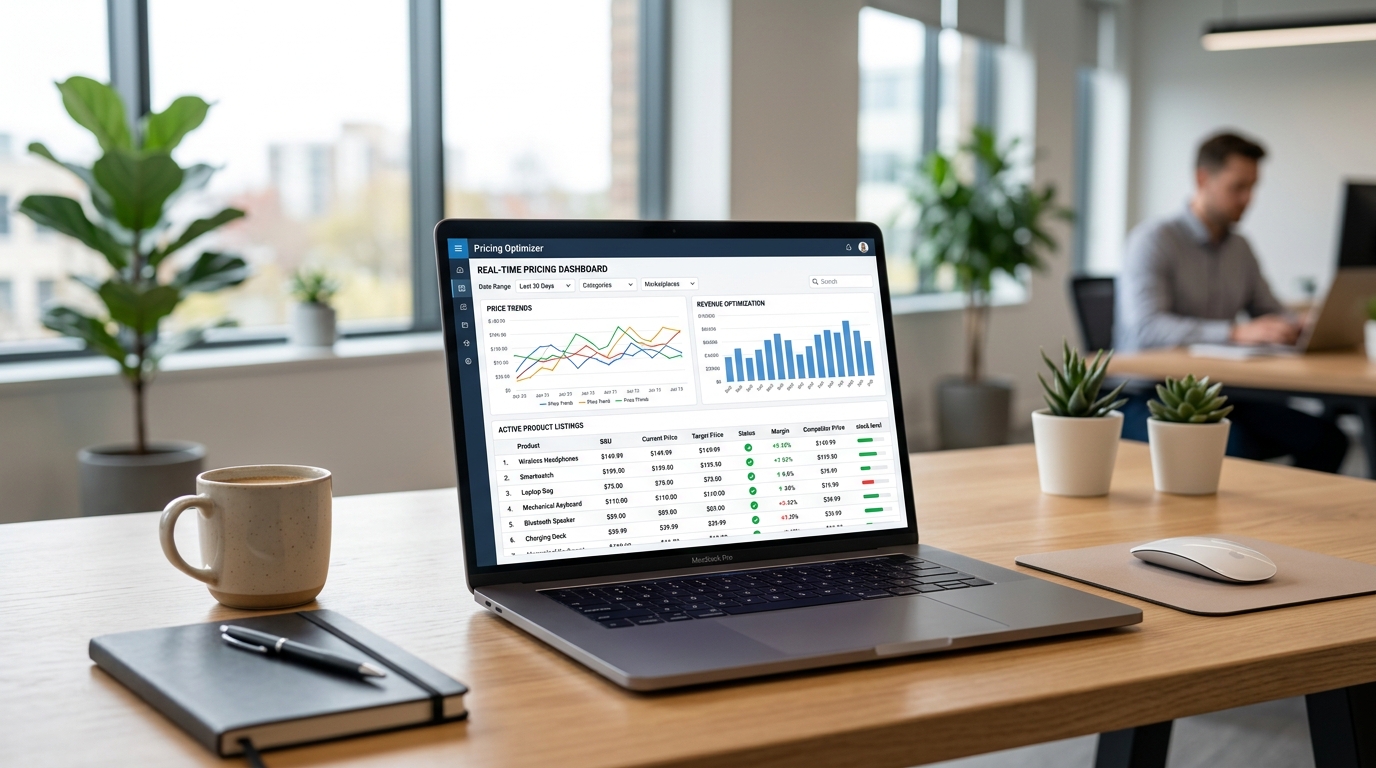
AI Dynamic Pricing for Shopify: Boost Revenue in 2026
AI dynamic pricing on Shopify lets your store automatically adjust product prices in real time based on demand signals, competitor pricing, inventory levels, and margin rules — capturing revenue you're currently leaving on the table during peak windows. The leading tools in 2026 (Prisync, Wiser, and emerging AI-native options) can lift revenue 5–25% in the right product categories when deployed with proper guardrails. Without guardrails, they can erode brand trust faster than any price increase saves.
- AI dynamic pricing adjusts prices automatically based on demand, competition, and margin rules — not random variation
- Revenue lift of 5–25% is achievable in the right categories; fashion, home goods, and seasonal accessories perform best
- Guardrails (floor/ceiling prices, customer-segment locks, display rules) are non-negotiable — unguarded dynamic pricing destroys trust
- Prisync and Wiser are the mature options; AI-native tools are worth testing in Q4 2026
- Start with a single SKU category and expand after proving the model
What AI Dynamic Pricing Is (and What It's Not)
Dynamic pricing has been standard in airlines and hotels for decades. What's changed in 2026 is that AI has made it accessible and intelligent enough for mid-market Shopify brands — not just enterprise retailers with 8-figure budgets and dedicated pricing teams.
What it actually is: A software layer that continuously ingests competitor prices, demand signals (traffic, add-to-cart rate, conversion rate), inventory levels, and your margin rules, then adjusts listed prices within defined bounds. Modern tools do this automatically, without a human approving every change.
What it isn't: Random price fluctuation. It isn't surge pricing that punishes loyal customers. And it isn't a set-and-forget system — it requires ongoing configuration, rule maintenance, and performance review.
The distinction matters because the brands that deploy dynamic pricing poorly (no floor prices, no customer-segment exceptions, no communication strategy) end up with angry repeat buyers who screenshotted yesterday's price and are now leaving 1-star reviews.
AI dynamic pricing for Shopify ecommerce is a margin optimization tool when done right. Done wrong, it's a brand reputation risk. The tooling has matured significantly — AI solutions are "moving from experimentation to core DTC operations" in 2026, including pricing optimization (ontapgroup.com). The implementation discipline is what separates the brands capturing margin lift from the ones creating customer service fires.
Best AI Pricing Tools for Shopify in 2026 (With Honest Trade-Offs)
| Tool | Best For | Shopify Integration | Starting Price | AI Repricing |
|---|---|---|---|---|
| Prisync | Mid-market, multi-SKU, competitor tracking | Native via API | ~$99/mo | Yes — competitor-aware |
| Wiser | Fashion, accessories, demand-driven | Native app | ~$150/mo | Yes — demand-driven |
| Quicklizard | Enterprise, catalogs 10K+ SKUs | API | Custom | Full ML pricing engine |
| Retailify | Small stores, starter budgets | Shopify App Store | ~$49/mo | Rule-based, limited AI |
Prisync is the most mature option for Shopify brands tracking competitor prices. It monitors competitor URLs automatically, feeds that data into pricing rules, and executes price changes via Shopify's API. AI dynamic pricing solutions like Prisync enable businesses to "optimize pricing strategies" in real time (ayautomate.com, 2026). It works especially well for commoditized categories — electronics accessories, supplements, home goods — where price parity with Amazon or specialty competitors directly affects conversion.
Wiser focuses more on demand-side signals than competitor tracking. It watches your own store's behavioral data (session velocity, add-to-cart rate, urgency signals) and modulates price accordingly. It's better suited for fashion and lifestyle brands where there isn't a direct competitor SKU to benchmark against.
Quicklizard is enterprise-grade — a full ML pricing engine built for catalogs of 10,000+ SKUs. Unless you're running that scale, the ROI math doesn't close at the starting price.
The emerging AI-native tools that launched in 2026 are worth watching but not yet mature enough for primary deployment. We'd recommend a small test cohort in Q4 2026 to evaluate output quality before committing budget. The category is moving fast; what's experimental today will be production-ready in 12 months.
Pricing Rules That Protect Margin Without Damaging Brand Perception
This is where most implementations succeed or fail. The AI does what you tell it to do — so what you tell it to do matters enormously.
Floor and ceiling prices are non-negotiable. Every SKU needs a hard floor (the minimum price that preserves margin and brand positioning) and a ceiling (the maximum price before perceived value breaks down). A $45 candle should never algorithmically hit $89 just because traffic spiked. Set a ceiling of +20–30% above baseline as a starting point and tighten from there based on category elasticity data.
Customer segment locks. Returning customers and loyalty members should be shielded from upward price adjustments. Nothing kills LTV faster than a repeat buyer seeing a 15% price increase from when they last purchased. Most tools support customer tag exclusions via Shopify — configure them before launch, not after the first complaint.
Competitor-relative rules. If your pricing strategy is "never more than 5% above Amazon for this category," hard-code that as a rule, not a guideline. AI tools will optimize for whatever objective you set; set the right objective. Vague goals produce vague results.
Reversion schedules. Prices that spike during high-demand windows should have automatic reversion triggers — either time-based (revert after 48 hours) or signal-based (revert when conversion rate drops below threshold). This prevents a temporary traffic surge from leaving you permanently overpriced after demand normalizes.
Transparency for bundles and subscriptions. Dynamic pricing should never apply to active subscriptions or bundle components where a customer has a price expectation baked in. Isolate those SKUs entirely — tag them in Shopify and explicitly exclude from the tool's rule set.
Which Product Categories Benefit Most From Dynamic Pricing
Not all products are equal candidates. Dynamic pricing in ecommerce can lift revenue by 5–25% when implemented with guardrails — and that range varies by category and competition density (industry pricing studies, 2026). Here's the decision framework:
High-potential categories:
- Seasonal and trend-driven items — demand spikes are predictable and short. Fashion accessories, holiday decor, seasonal apparel. Margins are fat at peak; dynamic pricing captures them before the window closes.
- Commoditized products with active competitor sets — if Amazon or a niche competitor sells the same or equivalent item, real-time price parity prevents loss of sales to comparison shoppers who check multiple tabs.
- Limited-inventory SKUs — as inventory depletes, price increases are both economically rational and commonly accepted. Customers understand scarcity pricing when it's transparent.
- Bundles and kits — component prices can be held static while bundle pricing flexes to optimize for AOV and margin contribution.
Low-potential / avoid:
- Hero / flagship SKUs — price is a brand statement here. Algorithmic variation undermines positioning and invites unfavorable comparisons.
- Subscription products — customers have price anchors; variation destroys retention faster than it builds margin.
- High-return categories — if customers are returning 30% of purchases, dynamic price increases will make the problem worse. Fix the return driver first.
- Low-velocity SKUs — not enough signal data for the AI to optimize against. Rules will fire on noise, not genuine demand signals.
Our AI & Automation practice evaluates category fit as the first step in any dynamic pricing engagement — because the wrong category choice produces negative ROI regardless of how good the tooling is. This is the part most brands skip, and it's the most important part.
Implementation Checklist — Setting Up Dynamic Pricing Without Breaking Your Store
Rolling out dynamic pricing is a 30-day project, not a 30-minute app install. Brands that rush this end up with pricing anomalies that generate customer complaints and manual cleanup work.
Week 1 — Audit and Baseline
- Export current prices and margins for all SKUs you're considering
- Tag SKUs by category, velocity, and return rate
- Set floor and ceiling prices for each candidate SKU — document in a spreadsheet before touching the tool
- Identify which customer segments are exempt (loyalty tiers, wholesale, active subscribers)
Week 2 — Tool Setup and Rules Configuration
- Connect your chosen tool to Shopify via API or native app
- Configure competitor tracking URLs (Prisync) or demand signal sources (Wiser)
- Input floor/ceiling rules for every candidate SKU — no exceptions
- Set customer tag exclusion rules and verify they're active before any price changes fire
- Enable audit logging — you want a complete record of every price change for the first 90 days
Week 3 — Limited Launch
- Activate on a single category only — your highest-velocity, mid-margin category is the right starting point
- Monitor conversion rate, margin, and return rate daily for 7 days
- Check for customer complaints or review spikes related to pricing
- Verify that exempt segments are actually exempt by testing with a loyalty-tagged account
Week 4 — Review and Expand
- Pull Week 3 performance data — compare revenue and margin to the equivalent prior period
- If positive: expand to the next category using the same rules architecture
- If negative or neutral: review rule configuration before expanding; don't assume the tool is broken
- Schedule a 30-day full review with your finance lead
The brands that get dynamic pricing right treat it as an ongoing operational practice, not a one-time setup. Quarterly rule reviews, monthly performance audits, and clear ownership (someone on your team owns the pricing config) are the difference between a tool that compounds value and one that creates chaos.
If you want a partner to build the automation layer correctly from day one, our AI & Automation practice (OpenClaw) handles dynamic pricing implementation as part of our ecommerce ops stack — including Shopify API configuration, rule architecture, and ongoing monitoring. We also work with brands on the broader pricing and merchandising strategy that makes dynamic pricing a genuine competitive advantage. And if you're still in the evaluation phase, our consulting team can run a pricing audit and tell you honestly whether your store is ready and which category to start with.
Frequently Asked Questions
Does dynamic pricing hurt customer trust on Shopify?
It can — but only when implemented without guardrails. Customers who see prices change dramatically between sessions, or who discover they paid more than a friend for the same item yesterday, will lose trust quickly. The solution is straightforward: set hard price ceilings that preserve perceived value, exclude returning customers and loyalty members from upward adjustments, and apply dynamic pricing only to categories where price variation is already an accepted norm (clearance, seasonal, limited inventory). When the rules are right, most customers never notice the pricing engine is running.
What kind of revenue lift can a Shopify brand realistically expect from AI dynamic pricing?
Industry studies and tool vendor case studies show 5–25% revenue lift, but the actual range depends heavily on category, catalog size, and rule quality. Fashion and seasonal categories tend toward the higher end; commoditized consumables trend lower. The most reliable gains come from floor-to-ceiling range optimization — capturing full-price sales during peak demand windows rather than leaving margin on the table. Brands with thin margins or heavy promotional calendars should model carefully before expecting the high end of that range.
How does AI dynamic pricing interact with Shopify discounts and compare-at prices?
Most tools adjust the "price" field in Shopify, not the "compare-at price" field — so the crossed-out original price display is not affected unless you configure it explicitly. If you run dynamic pricing upward during peak demand, the compare-at price (set manually) may end up lower than the live price, which looks odd to shoppers. Best practice: set compare-at prices only on genuinely marked-down items, and exclude those SKUs from dynamic pricing upward movement. Your tool's Shopify API configuration should handle this separation cleanly.
Is AI dynamic pricing legal for ecommerce brands?
In the United States, dynamic pricing is broadly legal for private-label and general ecommerce products. There are no federal laws prohibiting price variation based on demand or competition. The legal considerations are narrow: price discrimination based on protected characteristics is prohibited; subscription contract pricing must honor the agreed rate; some state-level consumer protection laws require price transparency for essential goods, which does not apply to typical DTC ecommerce categories. For fashion, home goods, accessories, and most DTC verticals: no issue.
What's the minimum catalog size where AI dynamic pricing makes sense?
There's no strict minimum, but the economics tend to pencil out at 200+ SKUs or $500K+ in annual revenue. Below that threshold, the tool cost and configuration overhead often outpace the margin gains — unless you're in a very high-margin, high-velocity category with clear competitor pricing to track. For smaller catalogs, manual pricing reviews (monthly competitor checks, seasonal price adjustments) often deliver 80% of the benefit at a fraction of the cost. If you're unsure whether your store is ready, our consulting team can run a quick pricing audit and give you an honest answer.
Ready to Build a Smarter Pricing Stack?
Most Shopify brands are running flat-price catalogs and giving up margin every peak demand window. Our AI & Automation practice implements dynamic pricing infrastructure — from tool selection and Shopify API configuration to rule architecture and ongoing performance monitoring. We also tie it into your broader ecommerce operations so pricing decisions work in concert with inventory, promotions, and your ad spend.
Talk to Our AI & Automation Team