Founder-led content ecommerce marketing strategy outperforms polished agency creative on Meta and TikTok — consistently, measurably, and by a wider margin each year. Unedited product demos and direct-to-camera founder explanations routinely beat studio-produced ads in click-through rate, cost-per-purchase, and thumb-stop rate. The issue isn't that founders don't know this. It's that they have no system for producing content without it consuming their entire week.
Why Founder-Led Content Outperforms Agency Creative in 2026
Creative quality now accounts for more than 50% of Meta Ads performance, according to Common Thread Collective's 2026 analysis. But "quality" in this context doesn't mean production value — it means authenticity signal. Polished brand ads trigger skepticism. A founder explaining why they built something, or showing how it works in their actual life, reads as genuine. That authenticity is the hook.
The data backs this up directly. Unedited product demos and founder-led content frequently outperform polished agency productions on Meta in 2026 (Common Thread Collective). On TikTok, content with strong hooks in the first 2–3 seconds and authentic production beats scripted brand spots by significant margins (Commerce Next, 2026). Both platforms are optimizing toward content that earns engagement organically — and founder content, by its nature, tends to do exactly that.
There's also a structural advantage most brands overlook: the same founder clip that performs organically can be whitelisted and run as a paid ad without losing its authenticity signal. Branded ad accounts carry a "Sponsored" label that creates psychological distance. A founder's account doesn't — and even when you run paid traffic from a founder's profile, audiences perceive it as more trustworthy than a brand posting the same content.
| Creative Type | Avg. Thumb-Stop Rate | Relative CTR vs Brand Ads | Production Cost |
|---|---|---|---|
| Polished brand video (agency-produced) | 18–22% | Baseline (1×) | $1,500–$8,000+ |
| Founder direct-to-camera (unedited) | 28–36% | 1.8–2.4× | $0 (time only) |
| UGC creator content | 30–38% | 2–4× | $150–$600/asset |
| Founder + light editing (captions, cuts) | 32–40% | 2.2–3× | $50–$200/asset (editing only) |
The cost efficiency is the part brands consistently underestimate. A single founder batch-recording session can produce 25–30 raw clips in a day. With basic editing, those clips become 3–4 weeks of organic content and a library of paid ad creative — at a fraction of what a UGC creator roster or agency retainer costs.
Building a Weekly Founder Content System Without Burning Out
The reason most founders abandon content creation isn't lack of ideas — it's the daily grind of trying to produce something new every morning before the rest of the business demands attention. The system that works is built on batch production, not daily creation.
The core structure: One focused recording session per month (3–4 hours) produces enough raw material for 4+ weeks of content. The rest of the month is scheduling, light engagement, and reviewing what worked.
Before you record, build a content bank. Spend 30 minutes collecting the 20–30 topics you'll record this month:
- Customer questions from email support and DMs (what do people ask most often?)
- The decision you made building this product that competitors would never admit
- One misconception about your category that costs customers money
- Behind-the-scenes moments: packaging runs, supplier visits, product failures
- Reactions to industry news or trends relevant to your niche
- Before/after or comparison demonstrations of your product
The topics that consistently perform best are ones where the founder has an opinion that differs from the default industry answer. Controversy (handled maturely) generates saves, shares, and comments — all of which signal quality to the algorithm and extend organic reach without paid amplification.
How to Batch-Record 30 Pieces of Content in One Day
Batch recording works because the hardest part of content creation is transitioning into "on camera" mode, not the recording itself. Once you're there, staying in that mode for a full session is more efficient than context-switching in and out of it daily.
Setup requirements (keep it simple):
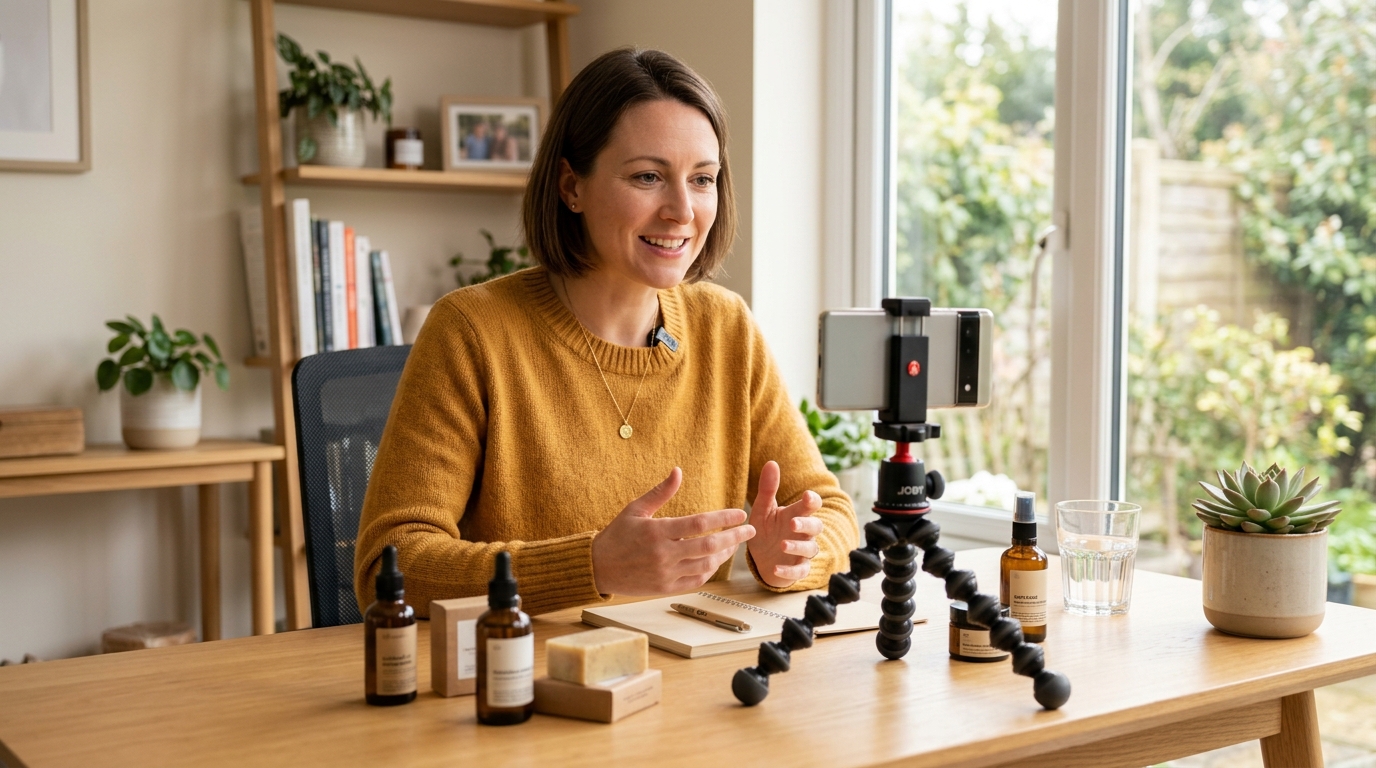
- Natural light source — a window is enough. Ring lights look artificial and flag the content as "produced."
- Phone on a tripod at eye level. Not tilted down, not handheld.
- Clean background, or intentionally authentic background (your office, warehouse, or kitchen table).
- External microphone if you're in a noisy environment — otherwise the phone mic is fine.
- No scripts. Bullet points maximum. Reading from a script is immediately visible and kills authenticity.
Session structure for 30 clips:
- Warm-up clips (5): casual, low-stakes topics to get comfortable. These may not get published.
- Core content (20): your actual topic bank, one clip per topic, 45–90 seconds each.
- Reaction and trend content (5): responses to things happening in your industry right now.
Record each clip in one or two takes. The instinct to re-record until perfect is the enemy of batch production. The rough edges are what make founder content work — one stumbled word doesn't kill a video; stopping and re-starting six times does, because the energy drops.
At the end of the session, you have 30 raw clips. Hand them to an editor (or use a VA) with a simple brief: add captions, cut dead air at the start and end, and clip to platform-appropriate length. That editing pass — not the recording — is what you should outsource if your time is constrained.
Repurposing Founder Content Across Meta, TikTok, Email, and Your Website
One of the structural advantages of founder content is that the same raw clip is usable across multiple channels with minor adaptation. A 90-second founder explanation doesn't need to be re-recorded for each platform — it needs to be re-edited for each context.
| Platform | Format | Key Adaptation | Best Use Case |
|---|---|---|---|
| TikTok (organic) | 15–60s vertical video | Strong hook in first 2s, trending audio layer, caption stickers | Discovery, brand awareness, comment engagement |
| Meta (organic) | Reels, Stories, Feed video | Direct CTA at end, link in bio reference | Warm audience engagement, retargeting pool building |
| Meta (paid) | Reels ad, feed video ad | Hook tightened to 1–2s, end card with offer | Cold audience acquisition, retargeting |
| GIF thumbnail + link to full video | Subject line teases the founder angle ("I wanted to be honest with you…") | List nurture, storytelling sequences | |
| Website / PDP | Embedded video, autoplay muted | Product-specific clip on the relevant product page | Conversion lift, trust signal on high-AOV products |
The email integration is particularly underused. Founder video clips embedded as GIF thumbnails in email campaigns consistently outperform static image emails on open-to-click rate — because the play button signals there's something to watch, which creates curiosity. Even if a subscriber doesn't click through to watch the full video, the presence of a founder's face in the email improves brand recall and purchase intent.
For brands building a full creator ecosystem alongside founder content, our post on the UGC content engine for ecommerce brands explains how to layer third-party creator content with your own founder assets without cannibalizing either channel.
Turning Founder Content Into Paid Ad Creative That Scales
Founder content has a paid advertising superpower: it doesn't look like an ad. Cold audiences are conditioned to skip anything that reads as a brand talking at them. A founder talking directly to camera — explaining a product decision, addressing a customer skepticism, or demonstrating something unexpected — reads as content, not advertising. That's what keeps the thumb from scrolling.
The paid adaptation process:
1. Identify your best organic performers first. Run organic content for 7–14 days before whitelisting or running paid. High organic engagement (especially saves and shares, not just views) predicts paid performance better than the view count alone.
2. Tighten the hook for paid. Organic viewers give you 2–3 seconds before scrolling. Paid audiences give you 1–1.5 seconds before the skip instinct kicks in. The first frame needs to contain a visible face, legible on-screen text, or an immediate visual hook. Cut any intro or setup from the organic version.
3. Record paid-specific variants. Some clips are worth recording directly for paid use with a hard offer at the end: "Use code FOUNDER20 for 20% off — link in bio." Organic content avoids hard CTAs; paid content needs one. Record both versions in the batch session and decide on deployment later.
4. Run from the founder's account when possible. Running paid ads from a founder's personal profile (via whitelisting or Meta's partnership ads) consistently outperforms the same creative running from the brand account. The authenticity signal survives the "Sponsored" label when the face and name are already familiar to the audience.
Creative quality now accounts for over 50% of Meta Ads performance. Founder content is the most cost-efficient way to hit that quality bar consistently — no studio booking, no agency brief cycle, no three-week production timeline. The constraint is the founder's time, which batch recording solves. For brands that want a structured approach to turning founder content into a full-scale paid creative system, our creative and content strategy team builds these workflows and connects them directly to paid media management so the content production and media buying operate as one system, not two separate efforts.
For context on how AI creative tools like Meta's Muse Image fit alongside founder content rather than replacing it, our post on Meta Brand Memory and Muse AI creative tools covers where AI creative has structural advantages — and where founder content still wins by a significant margin.
FAQ: Founder-Led Content Strategy for Ecommerce Brands
Does founder-led content work if I'm not comfortable on camera?
Yes — comfort improves with repetition, and the first batch is always the hardest. Most founders who now produce content consistently describe their first 10 videos as unwatchable and their next 30 as decent. The platform algorithms reward consistency over perfection, which means showing up regularly — even awkwardly — is more valuable than waiting until you feel camera-ready. Start with the formats that feel least intimidating: a product unboxing, a behind-the-scenes packing shot, or a quick answer to a customer question you get repeatedly.
How much time does a founder content system actually take per week?
A functional founder content system built around batch recording takes 2–4 hours one day per month, plus 30 minutes per week for scheduling and light engagement. The monthly batch session is where you produce 20–30 raw clips that get edited, captioned, and distributed across the following 4 weeks. That ratio — one focused production day per month in exchange for daily content output — is what makes the system sustainable for operators who can't be on camera every day.
Should I use my real name and face, or keep it brand-only?
Use your real name and face. Brand-only accounts consistently underperform founder-fronted accounts on both Meta and TikTok because the platforms reward content that signals genuine human presence. The founder's name also builds a personal brand asset that exists independently of the company — which has real value if you ever sell the brand, launch another product line, or want a press presence. The risk of over-personalizing your brand is smaller than the cost of staying anonymous.
Can I turn founder content into paid ads without it feeling different?
Yes — and this is one of the core advantages of founder content. When a founder records a direct-to-camera product explanation, that same clip can run as an organic post, a Meta paid ad, and a retargeting asset with minimal modification. The key is to record for paid use from the start: clean audio, clear lighting, no on-screen UI or watermarks, and a strong hook in the first two seconds. Clips recorded with paid use in mind will outperform polished brand ads because the authenticity signal survives the "Sponsored" label.
What types of founder content perform best on TikTok vs Meta?
TikTok rewards trend participation, unfiltered behind-the-scenes content, and direct engagement with comments — including stitching and duet formats. Meta rewards direct-response hooks, testimonial-style product demonstrations, and story-driven content that leads to a clear CTA. The same founder can succeed on both platforms, but the editing style, hook format, and call-to-action language should differ. On TikTok, blend into the content ecosystem. On Meta, be direct about what you're selling and why it works.
Ready to Turn Your Story Into a Scalable Content System?
Atlas helps ecommerce founders build content systems that connect organic storytelling to paid ad performance — without the production overhead. Talk to our creative team about building a founder content strategy for your brand.