Google Shopping Ads Holiday Playbook 2026
Maximize ROAS with Google Shopping ads this holiday season. The Q4 2026 playbook for ecommerce brands — feed optimization, Performance Max, and bidding.
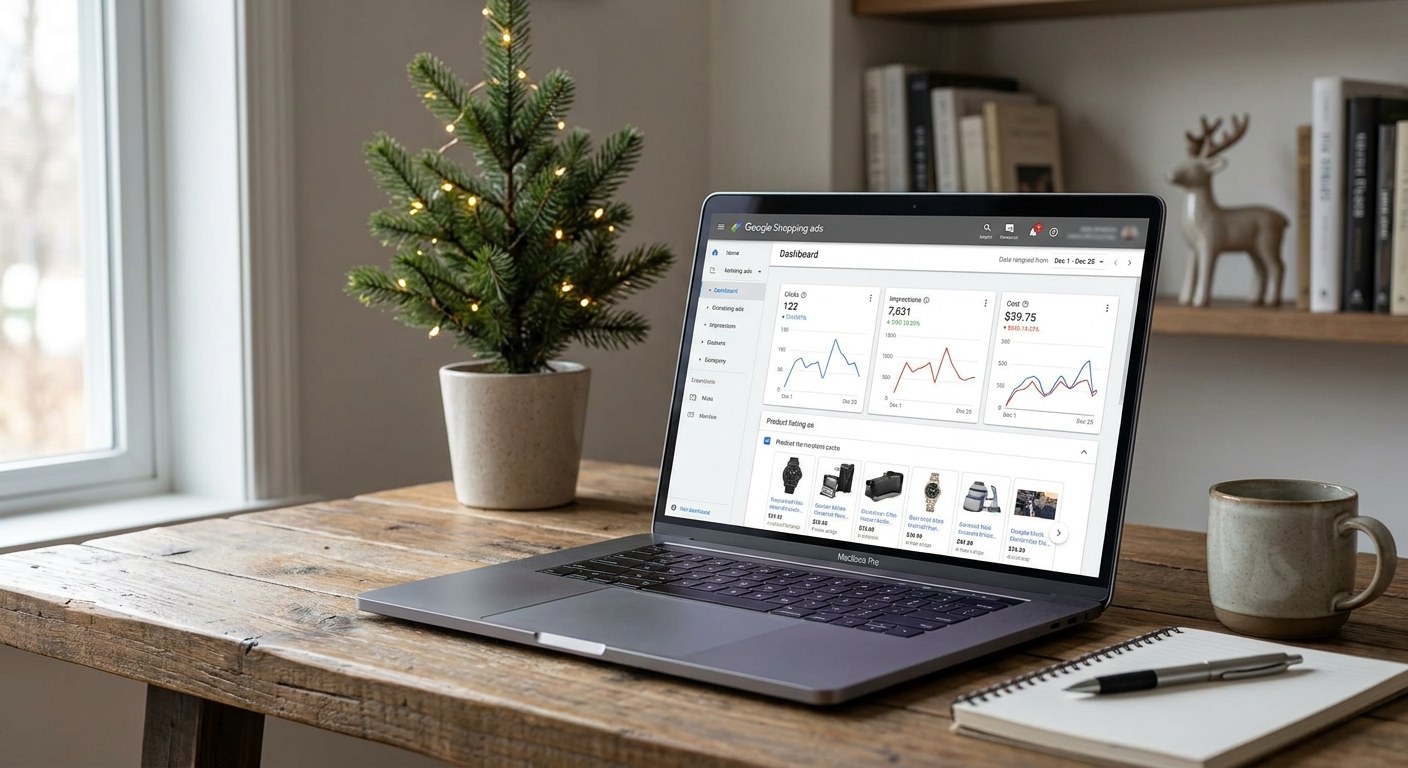
Google Shopping ROAS hit 8.03x in Q4 2025 — the highest of any paid channel. Yet most ecommerce brands walk into Q4 with 80% of their budget on Meta and a Shopping campaign that hasn't been touched since August. That's a structural error, and it's costing brands real revenue at the moment it matters most.
This is the Google Shopping ads holiday strategy 2026 playbook: feed optimization, Performance Max structure, bidding transitions, and measurement — built for brands that want to actually win the holiday season, not just show up.
TL;DR — Key Takeaways
- Google Shopping ROAS averaged 8.03x in Q4 2025 — higher than Meta, TikTok, or email
- Start your feed audit and campaign restructure in October, not November
- Performance Max outperforms Standard Shopping by 13% on conversions — but only with quality creative assets
- Switch from Target ROAS to Maximize Conversion Value with a ROAS floor during peak days (Nov 28–Dec 2)
- 37% of consumers plan to use AI for holiday shopping in 2026 — feed quality now directly determines AI recommendation eligibility
Why Google Shopping Outperforms Meta in Q4 (The Data)
Meta CPMs rose 12% year-over-year in H1 2026. TikTok CPMs are climbing as more brands flood the platform. At the same moment that paid social is getting more expensive, Google Shopping is delivering the strongest returns in the channel's history.
Google Shopping ROAS reached 8.03x in Q4 2025, according to eMarketer and Shopiator benchmarks. For context: Meta Advantage+ Shopping campaigns averaged 4.2x ROAS over the same period. TikTok Shop campaigns came in around 3.8x. In terms of paid acquisition, Google Shopping is the most efficient Q4 channel by a significant margin.
The reason is intent. When someone searches "Vitamix 5200 blender deal" or "men's winter jacket size L," they are not browsing — they have already decided to buy. They're comparison shopping, not discovering. Google Shopping captures that late-stage intent; Meta and TikTok are upper-funnel. In Q4, when every brand is competing for the same consumer attention, owning the bottom of the funnel is where the returns compound.
| Channel | Avg Q4 2025 ROAS | CPM Trend (YoY) | Intent Stage |
|---|---|---|---|
| Google Shopping | 8.03x | Stable | High (purchase-ready) |
| Meta Advantage+ | 4.2x | +12% | Mid to upper funnel |
| TikTok Shop | 3.8x | +9% | Upper to mid funnel |
| Google Demand Gen | 3.1x | Stable | Upper funnel |
There's a second factor for 2026 specifically: 37% of consumers now plan to use AI tools for holiday shopping research (Basis/eMarketer). Google's AI Overviews and AI Mode pull product data directly from Merchant Center feeds. A brand with a high-quality, complete feed shows up in AI-generated shopping comparisons; a brand with a thin feed doesn't exist in that surface. Feed quality in 2026 is not just an ads optimization decision — it determines whether you're visible to one-third of holiday shoppers at all.
The strategic implication: rebalance your Q4 budget toward Google Shopping now, before CPMs on Meta rise further and before your competitors do the same thing in late October.
Google Merchant Center Feed Optimization for the Holiday Season
A Performance Max campaign with a clean, complete feed will outperform a campaign with a dirty feed every time — regardless of budget. Start here in October.
Run a full feed audit. Log into Merchant Center and open the Diagnostics tab. Any product flagged as disapproved or limited needs to be fixed before November 1. The most common issues at scale: missing GTINs on branded products, price mismatches between the feed and your website (Google crawls this), images below 800×800px minimum resolution, and improperly formatted sale prices. Each disapproved product is a SKU Google cannot show — in Q4, that's revenue you're explicitly leaving off the table.
Schedule BFCM sale prices in the feed now. Google Merchant Center supports sale_price and sale_price_effective_date attributes. Set your BFCM promotional pricing to go live 48 hours before the event so Google has time to process the feed update and display the "sale" badge — the crossed-out original price next to the sale price. Merchants who schedule this correctly see CTR increases of 15–25% on Shopping ads during the sale window.
Populate product_highlight and product_detail attributes. These structured fields feed directly into Google's AI-generated product descriptions, Shopping Knowledge Panels, and AI Mode shopping summaries. In 2026, brands that populate these fields are far more likely to appear in AI-generated comparisons and agentic "Buy for Me" recommendations.
Use custom labels for margin-aware bidding. Apply custom_label_0 through custom_label_4 to tag products by margin tier, BFCM eligibility, category, or price range. This lets you create asset groups and bidding rules that push harder on high-margin products during the holiday rush rather than spending equally across a catalog with wildly different margin profiles.
Create Merchant Center promotions before peak. Submit a promotion (e.g., "20% off sitewide" or "Free shipping on orders $75+") at least 72 hours before you need it — approval takes 24–48 hours. This generates the "Special offer" tag in Shopping ads, which meaningfully improves CTR compared to Shopping ads without a promotion badge.
Performance Max vs. Standard Shopping: Which Structure Wins Q4?
The short answer: Performance Max wins on volume, Standard Shopping wins on control. For most ecommerce brands in Q4 2026, the right answer is both — running in a defined structure.
Performance Max campaigns drive 13% more conversions than Standard Shopping at comparable cost-per-acquisition, according to Google's own data. The trade-off is transparency: PMax tells you conversion volume and ROAS, but it doesn't reveal which placements, audiences, or search terms drove those conversions at a granular level. For Q4, when you want volume maximized, that trade-off is usually acceptable.
| Factor | Performance Max | Standard Shopping |
|---|---|---|
| Average conversion volume | +13% vs. Standard | Baseline |
| Control over placements | Limited | Moderate |
| Transparency (search terms) | Low | Higher |
| Creative flexibility | High (all asset types) | Limited (product feed only) |
| Best for | Volume, scale, ROAS efficiency | Brand terms, specific SKU control |
| Recommended Q4 budget split | 70–80% | 20–30% |
The recommended Q4 structure: Run Performance Max as your primary campaign with dedicated asset groups by product category or margin tier. Use a Standard Shopping campaign in parallel — set at a lower priority — to capture your branded search terms and highest-margin SKUs where you want manual bid control.
Asset group discipline matters. PMax performs significantly better when each asset group has a coherent theme — same product category, same audience intent, same creative message. A single PMax campaign with all your products in one asset group gives Google's algorithm too little signal to optimize against. Create at minimum: one asset group per major category (e.g., Apparel, Home Goods, Electronics), plus a dedicated asset group for your top 20% of SKUs by revenue.
Supply quality creative assets. PMax uses images, videos, headlines, and descriptions across Search, Display, YouTube, and Discovery. Brands that supply only the minimum assets hand over creative decisions to Google's AI generation, which produces generic results. Supply at least 5 high-quality lifestyle images, 3–5 headlines, and ideally one 15–30 second video per asset group. Holiday-specific creative outperforms evergreen creative by 20–40% during Q4.
Bidding Strategy and Budget Timing: October Through December
The biggest Q4 Shopping mistake is treating October, November, and December as one continuous period. They're three distinct phases with different bidding logic.
October (now): Learning and building. Run Target ROAS bidding at a target 10–15% above your historical benchmark. The goal is to build algorithm learning history before CPMs spike. Don't chase efficiency — prioritize feeding Google's algorithms high-quality signal data so the system can bid accurately when it matters. If you haven't run PMax before, launch now. The learning phase takes 2–6 weeks.
November 1–22 (pre-BFCM warmup). Hold Target ROAS steady and begin scaling daily budgets gradually — increase by 20–30% per week rather than spiking the budget abruptly. Google's algorithm needs 24–48 hours to adjust to a significant budget increase; if you jump from $500/day to $5,000/day on Black Friday morning, you'll burn the first 24 hours inefficiently.
November 28–December 2 (BFCM peak). Switch from Target ROAS to Maximize Conversion Value with a ROAS floor (not a ceiling). This tells Google: "Spend aggressively, but don't go below X ROAS." Set the ROAS floor 15–20% below your normal target to give the algorithm room to capture volume during peak intent. Raise daily budgets to 3–5x your October baseline.
December 3–20 (post-BFCM, last-shipping urgency). Return to Target ROAS bidding. Focus on "last order date" creative and messaging around guaranteed delivery. Introduce countdown-timer ad copy via ad customizers for shipping deadlines. High-AOV products typically see strong conversion rates in this window as consumers complete remaining gift purchases.
December 21–January 2 (last-minute and gift cards). Scale back Shopping for physical products once shipping deadlines pass. Shift budget toward digital gift cards (if applicable) and retention campaigns. Begin planning January clearance structure.
Holiday-Specific Ad Copy, Promotions, and Extensions
Google Shopping ad copy lives in your feed titles and descriptions — not traditional ad text. This is where most brands underinvest.
Feed title optimization for Q4. Your product title is the single most important Shopping signal. The formula: [Brand] + [Product Name] + [Key Attribute] + [Holiday Signal]. Example: "Levi's 511 Slim Fit Jeans Men's 32x32 — Holiday Gift" outperforms "Levi's Jeans" on both click-through and ranking. Add holiday-intent terms to your top-selling products' titles in October, before CPMs peak.
Promotional extensions via Merchant Center. Merchant Center promotions generate the "Special offer" label in Shopping ads. Beyond the banner benefit, promotions also qualify your products for inclusion in Google's "Deals" and "Sale" filters — surfaces that see enormous traffic spikes during BFCM and December. Brands not running Merchant Center promotions are invisible in those filtered searches.
Callout extensions and structured snippets. Use callout extensions for urgency ("Free 2-Day Shipping," "In Stock," "30-Day Returns") and structured snippets to list product categories. These appear below your Shopping ads on broad match placements and improve CTR without additional bidding cost.
Price extensions for consideration. If you're running Shopping alongside Search, price extensions display product options directly in the search ad — effectively showing a mini-Shopping carousel inside a text ad. This is particularly effective for brands with multiple price points in the same category.
Attribution and Measurement When Multiple Channels Run Hot
Q4 is when attribution breaks down for brands running Google, Meta, TikTok, and email simultaneously. Every channel claims credit; the real source of truth is harder to find.
Google's data-driven attribution (DDA) — the default in GA4 and Google Ads — distributes credit across the conversion path based on observed touchpoint influence. It's more accurate than last-click, but it still operates within Google's ecosystem and cannot see Meta or TikTok touchpoints.
The right Q4 measurement stack: Use DDA attribution for Google channels with a 30-day click, 1-day view attribution window for Shopping. Use 7-day click, 1-day view in Meta for direct response. Your north-star metric should be MER (Marketing Efficiency Ratio) — total revenue divided by total ad spend across all channels. MER doesn't lie the way platform-reported ROAS does. If MER rises as you scale Google Shopping, the channel is contributing net-positively.
Run a geo holdout test in one DMA for two weeks in October to establish Google Shopping incrementality before peak. Pull Google Shopping from a test region, maintain everything else, and measure the revenue delta. This gives you a defensible, channel-agnostic conversion rate to apply through Q4.
37% of consumers plan to use AI for holiday shopping in 2026. AI-referred sessions from Google's AI Overviews and AI Mode typically don't carry UTM parameters — they'll show as direct or organic in GA4. If you see a spike in direct traffic that correlates with Shopping campaign activity, that's likely AI-referred traffic. Build this assumption into your Q4 measurement framework so you're not undervaluing Google's contribution.
Our performance marketing team helps ecommerce brands build cross-channel attribution frameworks that give an accurate picture of Q4 efficiency — not just what each platform reports about itself.
FAQ
How much budget should I shift to Google Shopping for Q4 2026?
The right allocation depends on your current channel mix, but a useful benchmark: brands that historically over-index on Meta (70%+ of paid budget) should move toward a 50/50 split with Google Shopping in Q4. If you're already running Shopping at 30–40% of budget, consider pushing it to 50% given the ROAS advantage. The rebalancing should happen in October — not in November when CPMs on Meta have already spiked and Google's learning phase hasn't had time to run.
Is Performance Max worth it for ecommerce in Q4, or should I stick with Standard Shopping?
Performance Max is worth it if — and only if — you supply quality creative assets and structured audience signals. Brands that launch PMax with minimal assets and no audience lists consistently underperform Standard Shopping. Done correctly, PMax generates 13% more conversions at comparable CPA. The recommended Q4 structure is 70–80% of Shopping budget in PMax with dedicated asset groups by category, and 20–30% in Standard Shopping for branded and high-margin SKU control.
When should I start Q4 Google Shopping preparation?
October 1 is the right start date for feed audit and campaign restructure. The PMax learning phase takes 2–6 weeks — starting in October means the algorithm is trained and stable before BFCM. Feed updates for BFCM sale pricing should be submitted by November 22 to allow processing time. Merchant Center promotions need 72 hours for approval, so submit those by November 25 at the latest.
What ROAS should I target for Google Shopping in Q4?
Set your Target ROAS at 10–15% above your historical benchmark during October and early November. During BFCM weekend (Nov 28–Dec 2), switch to Maximize Conversion Value with a ROAS floor set 15–20% below your normal target. This allows Google to capture volume during peak intent without cratering efficiency. Post-BFCM, return to your standard ROAS target and focus on shipping deadline urgency messaging through mid-December.
How does Google's AI Mode affect Shopping ads in Q4 2026?
Google's AI Mode uses Merchant Center feed data to generate shopping comparisons and — in some cases — complete purchases on behalf of users. Brands with complete product_highlight, product_detail, and rich structured attributes are more likely to appear in AI-generated comparisons and agentic recommendations. Feed quality is no longer just an ads optimization — it determines eligibility for a surface that 37% of holiday shoppers plan to use in 2026.
Ready to Win Q4 with Google Shopping?
If you're heading into the holiday season with under-optimized Shopping campaigns or an unstructured PMax setup, the window to fix it is now — not November. Our team manages Google Shopping and performance marketing for ecommerce brands, including full feed audits, PMax architecture, and bidding strategy. We also offer ecommerce consulting for brands that need a broader Q4 strategy beyond paid channels.
Talk to Our Team