Klaviyo AI Agents: Retention Flows in 2026
Klaviyo's 2026 AI agents automate retention flows that drive 50–60% of email revenue. Here's how to build them for your ecommerce brand.
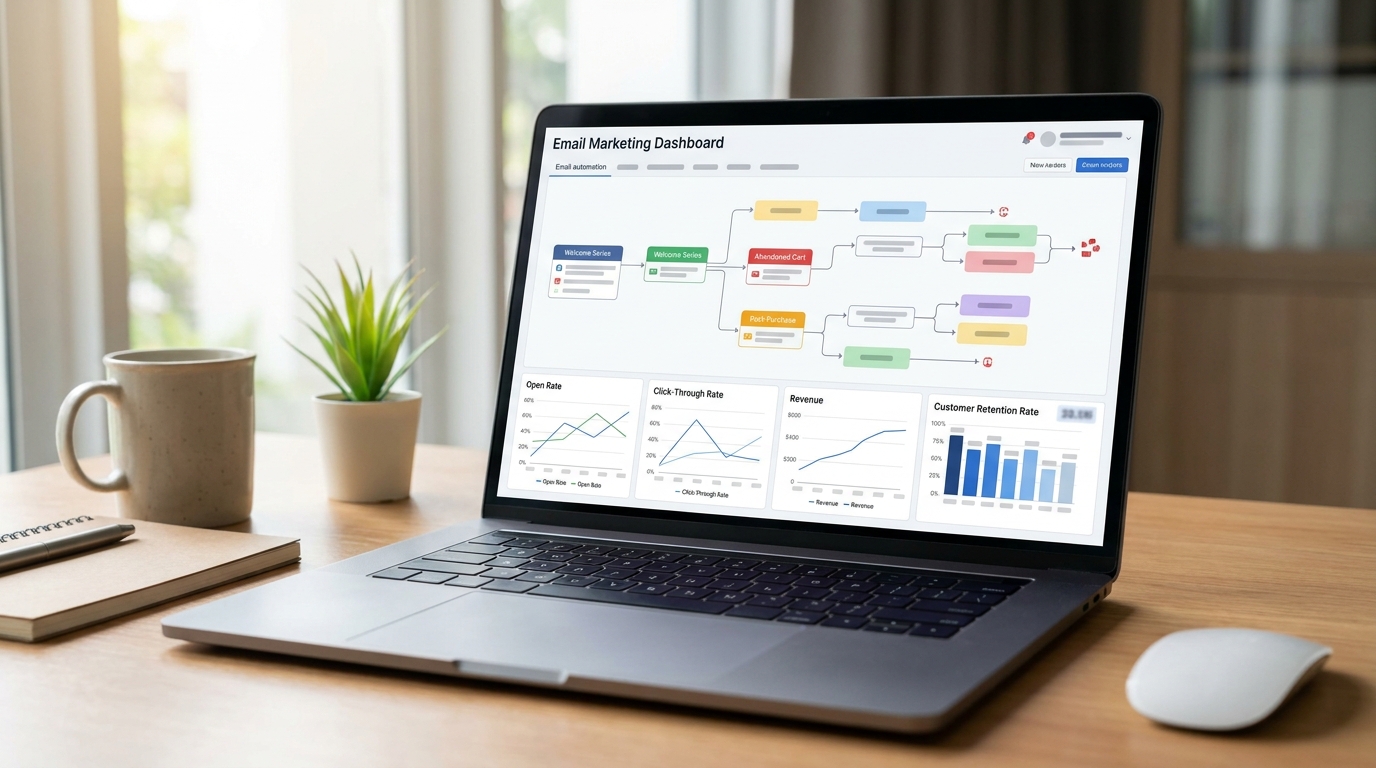
Klaviyo AI flows for ecommerce retention now do what used to require a full-time email strategist: build predictive segments, trigger personalized sequences, and optimize send timing — automatically. For mature ecommerce programs, automated flows already drive 50–60% of total email revenue. With Klaviyo's 2026 AI overhaul — the Composer agent and Customer Agent — that number is climbing, and brands that haven't updated their flow architecture are leaving a measurable chunk of revenue on the table.
TL;DR — Key Takeaways
- Klaviyo's rebuilt engine processes 74,000+ profiles per second — timing delays are gone; your strategy is the bottleneck now
- Automated flows drive 50–60% of total email revenue for mature programs; AI makes them faster to build and smarter to run
- Predictive segments consistently outperform demographic ones on revenue per recipient
- Multi-channel stacks (email + SMS + WhatsApp) multiply retention impact but require deliberate sequencing to avoid fatigue
- The five highest-ROI flows are: welcome series, abandoned cart, browse abandonment, post-purchase, and win-back
Why Klaviyo's 2026 AI Update Changes the Retention Game
Most Klaviyo guides open with the familiar pitch: set up your flows, segment your list, watch revenue roll in. That advice isn't wrong — but it describes the 2022 playbook, not the 2026 one.
Klaviyo's rebuilt processing engine now handles over 74,000 profiles per second. What that means practically: the latency that used to plague large lists — the 15-minute lag between a customer action and a triggered email — is gone. Your abandoned cart email can fire within seconds of exit. Your post-purchase sequence can react to a return request in real time.
The bottleneck has shifted. It's no longer the platform; it's the strategy sitting on top of it. Brands that built flows two or three years ago and haven't revisited them are running fast infrastructure on slow logic.
The 2026 AI update addresses this directly. Klaviyo didn't just speed up the engine — they added two agent-layer tools (Composer and Customer Agent) that bring autonomous decision-making into the flow builder itself. This isn't AI as a gimmick. It's AI as an ops layer that monitors behavior, rewrites segments on the fly, and surfaces recommendations before your team spots the pattern.
For ecommerce operators, the implication is straightforward: retention email is no longer a set-it-and-optimize-it quarterly task. It's an always-on system that improves with every send. Understanding how AI inboxes score your email deliverability is the essential foundation — flows are only as effective as the percentage that reach the primary inbox.
The Five Flows That Drive 80% of Email Revenue (and How to Automate Them with AI)
Most ecommerce brands have too many flows and too few good ones. The following five account for roughly 80% of email-attributed revenue for mature programs. For each, the AI layer changes what "set it up" actually means in 2026.
1. Welcome Series
The welcome series captures intent at its highest. New subscribers and first-time visitors have just self-selected — they are, by definition, interested. A well-built welcome flow in 2026 doesn't just deliver a discount; it runs a preference mini-quiz in email two and routes subscribers into product-specific sequences based on their responses.
With Composer, you can build this branching logic in plain language and let the agent write the conditional steps. The output isn't perfect, but it gets you to 80% in a fraction of the time.
2. Abandoned Cart
Abandoned cart is the highest-intent trigger in email marketing. The customer picked a product, evaluated it, and left. They know what they want — they just need a nudge.
The AI upgrade here is timing optimization. Klaviyo's predictive engine now calculates the optimal send window per subscriber based on their historical open patterns, not a fixed one-hour delay. For brands with large lists, this alone moves the needle on recovery rates.
3. Browse Abandonment
Browse abandonment is underused relative to its potential. Customers who view a product page — especially multiple times — are signaling consideration. A well-sequenced browse abandonment flow (3 emails over 48 hours) captures a segment that otherwise disappears silently.
The 2026 AI layer adds product affinity scoring. If a customer has browsed similar items repeatedly, Klaviyo can surface cross-category recommendations rather than replaying the same product — reducing the staleness that kills click-through rates.
4. Post-Purchase
The post-purchase flow is where brands either build loyalty or lose it. A generic "thanks for your order" email is a missed opportunity. A well-built post-purchase sequence includes: order confirmation, shipping update, product care and use tips (a retention driver that reduces returns), a review request at the right moment, and a cross-sell trigger calibrated to the purchased category.
The AI layer in 2026 handles the cross-sell recommendation automatically. Rather than manually mapping product A to product B in Klaviyo's recommendation block, the Customer Agent learns purchase patterns across your catalog and surfaces the statistically strongest next-buy recommendation per subscriber.
5. Win-Back
The win-back flow targets subscribers who haven't purchased in a defined window — typically 90–180 days. Most brands run a two-email win-back with a discount. The smarter approach — and what AI makes easier to execute — is a segmented win-back that varies the message based on purchase history.
A customer who bought once at full price gets a different win-back than one who only buys on sale. Treating them identically is the most common win-back mistake. Klaviyo's predictive CLV data makes it straightforward to build these branches without manual list manipulation.
| Flow | Primary Trigger | AI Enhancement in 2026 | Revenue Tier |
|---|---|---|---|
| Welcome Series | New subscriber / first visit | Preference routing, dynamic branching | High |
| Abandoned Cart | Cart created, no purchase | Per-subscriber send time optimization | Very High |
| Browse Abandonment | Product page view, no add to cart | Product affinity cross-sell | High |
| Post-Purchase | Order confirmed | AI-powered cross-sell recommendation | High |
| Win-Back | 90–180 days no purchase | Segment by purchase behavior / CLV | Medium-High |
Composer and Customer Agent: What They Do and How to Use Them
Klaviyo's two new AI tools are distinct in function. Conflating them leads to underutilizing both.
Composer is a flow-building agent. You describe what you want in natural language — "build a 5-email abandoned cart sequence that branches based on cart value, with SMS on day two for subscribers who've opted in" — and Composer generates the flow structure, writes draft copy for each step, and sets up the conditional logic. It's not a replacement for a skilled email strategist; it's an accelerator that removes the blank-canvas problem and compresses build time from days to hours.
Where Composer falls short: it doesn't know your brand voice without being trained on examples. Feed it 5–10 of your best-performing past emails before generating new flows. The output quality jumps significantly.
Customer Agent operates differently. It's an autonomous monitoring layer that runs in the background, watching engagement signals across your subscriber base. It identifies subscribers trending toward churn before they've technically lapsed, flags segments that are outperforming or underperforming benchmarks, and surfaces recommended actions — new flows to build, segments to suppress, send cadence to adjust.
Think of Customer Agent as a proactive analyst. It doesn't execute changes on your behalf (yet), but it shortens the feedback loop between data and decision from weeks to hours.
How to activate both effectively:
- Start with Composer to rebuild or update your five core flows
- Enable Customer Agent monitoring and review its weekly digest
- Use Customer Agent insights to prompt your next Composer build — closing the loop between performance data and flow iteration
Predictive Segments vs. Demographic Segments: The Revenue Difference
The standard segmentation playbook — segment by gender, age, location, purchase history — gets the job done. But it leaves money on the table compared to predictive segmentation, and in 2026, Klaviyo's predictive layer makes the upgrade accessible without a data science team.
Demographic segmentation asks: who are these people? It groups subscribers by static attributes. It's useful for relevance (a 40-year-old man probably doesn't need the women's shoe flow), but it's a blunt instrument for predicting buying behavior.
Predictive segmentation asks: what is this person likely to do next? Klaviyo's models calculate, per subscriber:
- Predicted CLV — expected total spend over the next 12 months
- Churn risk score — probability of becoming inactive
- Next purchase date prediction — estimated window for the next transaction
- Product affinity — category and price point preferences inferred from behavior
AI-driven predictive segments show significantly higher revenue per recipient compared to demographic segmentation alone, according to Klaviyo's 2026 platform data. The mechanism is straightforward: you're sending the right offer to people who are actually likely to buy, rather than people who look demographically similar to past buyers.
Practical example: Instead of "female customers who bought skincare last quarter," your segment becomes "subscribers with high predicted CLV, churn risk above 30%, and affinity for premium skincare." The second group is smaller but statistically more likely to convert on a win-back offer — meaning you spend less send volume and discount budget capturing more revenue.
| Segment Type | Logic | Best Use Case | Avg. Revenue Per Recipient |
|---|---|---|---|
| Demographic (gender + age) | Static attributes | Broad product relevance | Baseline |
| Purchase history | Past behavior | Category-based flows | +15–25% vs. demographic |
| Predictive CLV + churn risk | ML-modeled future behavior | Win-back, VIP, re-engagement | +20–40% vs. demographic |
| Product affinity | Browse + purchase pattern | Cross-sell, upsell flows | +20–35% vs. demographic |
Segment types to build first:
- High CLV, low purchase recency (prime win-back candidates)
- First-purchase-only customers with rising churn risk (convert to repeat before they lapse)
- High browse-to-purchase ratio (engage differently than direct buyers)
- SMS + email opted-in (highest engagement ceiling — treat as VIP tier)
WhatsApp, SMS, and Email: Building a Multi-Channel Retention Stack
Email is the foundation. SMS adds urgency. WhatsApp adds conversational depth. Used together thoughtfully, they multiply retention impact. Used carelessly, they accelerate unsubscribes.
The principle governing multi-channel stacks: channel by urgency, not by volume. Each channel has a natural register, and crossing wires kills effectiveness.
Email: Long-form, information-rich, best for post-purchase education, product launches, newsletters, and sequences that benefit from visual layout. Open rate benchmarks sit at 35–45% for well-managed ecommerce lists.
SMS: Short, urgent, action-oriented. Best for cart abandonment (as a second touch after email), flash sales, back-in-stock alerts, and order shipping confirmations. SMS should never exceed 2–3 messages per week per subscriber, and every message needs an obvious opt-out path.
WhatsApp: Increasingly viable for ecommerce in markets where WhatsApp is the primary messaging app. Best for order support, personalized product recommendations via chatbot, and VIP loyalty communication. Klaviyo's WhatsApp integration (expanded in 2026) allows flow triggers to cross channels — an email open can trigger a WhatsApp follow-up for subscribers who haven't clicked after 48 hours.
Sequencing logic to implement:
- Email fires first (lower friction, higher information capacity)
- SMS fires 2–4 hours later if no open or click (urgency escalation)
- WhatsApp fires for high-CLV subscribers only if SMS goes unread (VIP treatment, not blast)
The goal isn't to reach every subscriber on every channel. It's to reach the right subscriber on the channel they're most likely to respond to, at the moment they're most likely to engage. Klaviyo's Customer Agent, combined with predictive CLV scoring, makes this routing increasingly automated.
Our team at Atlas manages Klaviyo retention programs as part of our email and SMS marketing services for ecommerce brands. The multi-channel stack above is the architecture we implement for clients scaling past $2M in annual revenue — at that tier, the infrastructure pays for itself within the first quarter.
If your Shopify store is the engine, your retention stack is the fuel. We cover Shopify store development and optimization as a parallel service for brands that want both sides of the equation handled.
FAQ: Klaviyo AI for Ecommerce Retention
How much of my email revenue should be coming from automated flows vs. campaigns?
For a mature ecommerce email program, automated flows should account for 50–60% of total email-attributed revenue. If your flows are generating less than 40%, it's typically a sign that the core five flows (welcome, abandoned cart, browse abandonment, post-purchase, win-back) aren't fully built out or haven't been optimized in the past 12 months. Campaigns — newsletters, product launches, promotions — fill the rest, but they require ongoing creative effort. Flows compound; campaigns don't.
Is Klaviyo's AI worth it for smaller ecommerce brands, or is it overkill?
Klaviyo's AI features are available across plan tiers, though some predictive analytics require a minimum list size to generate statistically reliable models — typically 500–1,000 active subscribers minimum. For brands under that threshold, the AI tools function but the recommendations are less reliable. The practical answer: if you have 1,000+ subscribers and aren't using predictive CLV segments or Composer to build flows, you're leaving functionality you're already paying for unused. Start there before evaluating whether to upgrade.
What's the difference between Klaviyo Composer and just using a copywriting AI tool like ChatGPT?
The difference is context. A general-purpose AI writing tool has no access to your Klaviyo account — your flows, segments, historical performance data, or product catalog. Composer is embedded in the platform and can reference all of it. When you ask Composer to write a win-back sequence, it calibrates the tone and offer to your actual audience behavior. That said, Composer-generated copy still needs review and brand voice editing — it's an accelerator, not a ghostwriter.
How do I know if my predictive segments are actually performing better than my old demographic ones?
Run an A/B test over 30 days: send the same offer to a demographic segment (matched on size) and a predictive CLV segment targeting a similar audience profile. Compare revenue per recipient — total revenue attributed to email divided by segment size — not just open rate. Revenue per recipient is the metric that shows whether the segment is converting, not just engaging. In our experience managing Klaviyo programs, predictive segments consistently show 20–40% higher revenue per recipient on win-back and post-purchase flows.
How often should I be updating my Klaviyo flows?
At minimum, review your core flows quarterly — check metrics on each step (open rate, click rate, conversion rate, unsubscribe rate) and identify drop-off points. With Customer Agent active, you'll get automated alerts when a flow step's performance dips below baseline, which can shortcut the audit process. Beyond metrics, rebuild flows any time Klaviyo rolls out a significant feature update — new functionality in the flow builder often enables sequences that weren't possible before.
Ready to Build a Retention Program That Actually Compounds?
Klaviyo's 2026 tools lower the barrier to building a sophisticated retention engine — but the strategy still has to be right. Flows built on the wrong segment logic or with copy that doesn't match your brand voice won't perform, regardless of how fast the platform processes them.
Our team at Atlas builds and manages end-to-end Klaviyo retention programs for ecommerce brands, from flow architecture and copy through predictive segmentation and multi-channel stack setup. If your program isn't generating 50%+ of email revenue from automated flows, there's a concrete gap we can close.
Talk to our email and SMS team