Progressive Web Apps vs Native Apps for Ecommerce: The 2026 Decision Guide
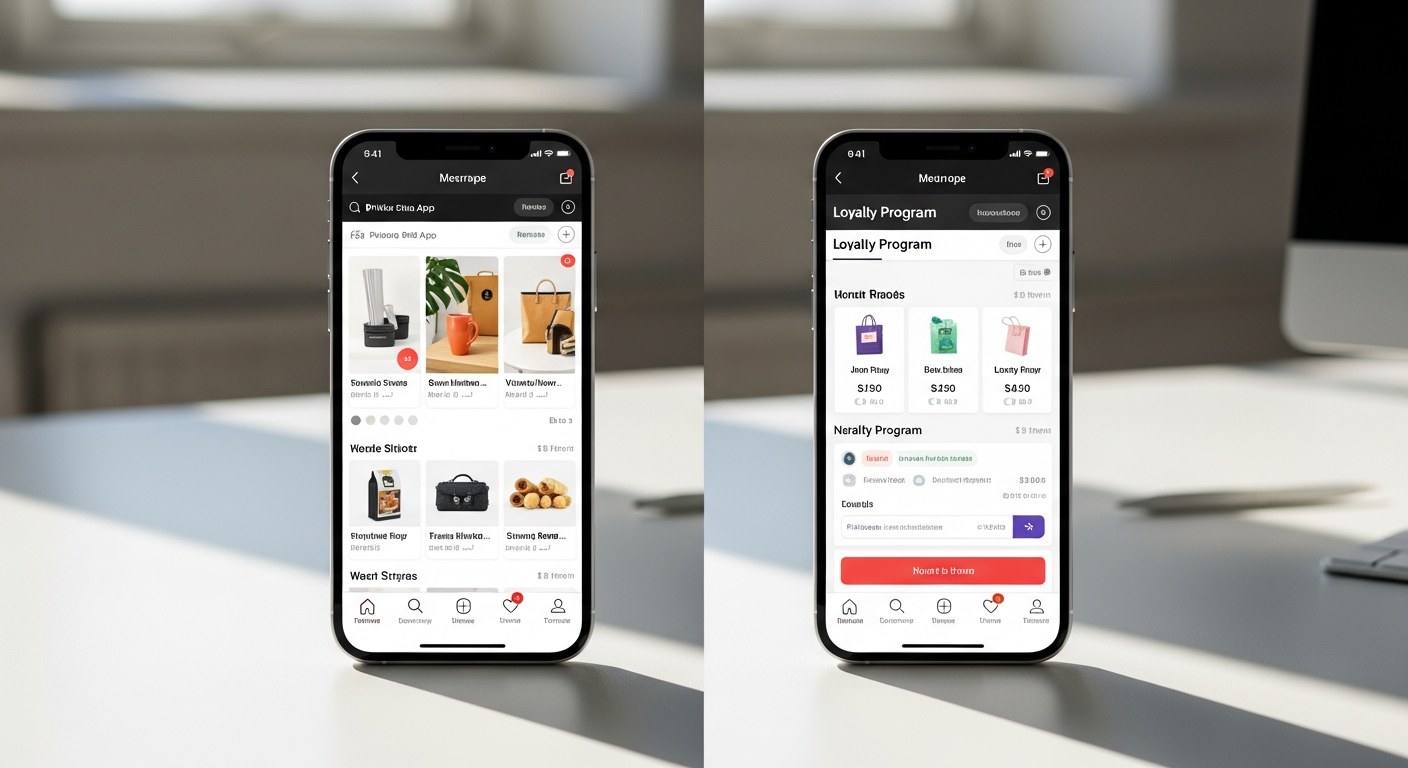
For most ecommerce brands deciding between a progressive web app vs native app, the answer comes down to three variables: repeat purchase rate, budget, and which native device features you actually need. A PWA delivers app-like mobile experiences at a fraction of the cost — no app store required. A native iOS/Android app unlocks deeper device integrations and the full App Store discovery surface, but comes with significantly higher development and maintenance overhead.
TL;DR — Key Takeaways
- PWAs load 36% faster than standard mobile sites and cost 30–50% less to build than native apps
- Native apps outperform PWAs on repeat purchase rate and session duration for brands with loyalty or subscription layers
- If your repeat purchase rate is below 40%, a well-built PWA almost always delivers better ROI than a native app
- The decision is not about technology preference — it's about your customer behavior and revenue model
- Most Shopify brands don't need either: Shopify's native mobile tools cover the majority of use cases
The Core Difference: What PWA and Native App Actually Mean for Ecommerce
A Progressive Web App (PWA) is a website that behaves like a mobile app. It loads in the browser, can be installed on the home screen, works offline or in low-connectivity environments, and supports push notifications. Users don't download it from the App Store or Google Play — they access it via URL, and the browser handles the rest.
A native app is purpose-built for iOS or Android. It's submitted to the App Store or Google Play, downloaded to the user's device, and has full access to native hardware: camera, biometrics, GPS, Bluetooth, NFC, and device-level notifications. It's also a significantly larger investment.
For ecommerce, the practical difference is this: a PWA closes the mobile experience gap without the app store overhead. A native app goes further — but only delivers ROI if your business model actually needs what it unlocks.
What a PWA Can and Cannot Do in 2026
PWAs have matured considerably. In 2026, a well-built ecommerce PWA can do the following:
- Home screen installation — users can save it with one tap, creating a near-native launch experience
- Offline browsing — product catalog, recent orders, and saved items remain accessible without a connection
- Push notifications — cart abandonment alerts, back-in-stock notifications, and order updates
- Fast load times — PWAs load 36% faster than standard mobile sites through service worker caching and efficient asset delivery
- Payment integrations — Apple Pay, Google Pay, and Shop Pay work natively in PWA environments
What a PWA cannot do:
- App Store distribution — no organic discovery through Apple's App Store or Google Play browsing
- Deep native hardware access — biometric authentication, Bluetooth pairing, NFC (though some of these are partially accessible via newer browser APIs)
- Background sync beyond browser limits — complex background processing is restricted compared to native
- iOS push notifications without user install — Apple's PWA push support improved in iOS 16.4+, but install rates remain lower than Android
For the majority of ecommerce use cases — browse, discover, cart, checkout, account — a PWA covers it.
What a Native App Unlocks That a PWA Can't
The case for a native app comes down to a specific cluster of use cases where native hardware and App Store distribution create real business value.
Loyalty and subscription UX. Native apps deliver the highest-performing loyalty program experiences — biometric login, personalized push with rich media, home screen widgets showing points balances, and subscription management dashboards that feel native rather than web-wrapped.
App Store discovery. Both the Apple App Store and Google Play are real discovery channels. Brands with strong review velocity and ASO (App Store Optimization) can acquire users who would never find the web store through a search query.
Push notification depth. Native push notifications outperform web push in open rates, rich media support (images, action buttons), and delivery reliability — particularly on iOS, where PWA push support remains inconsistent.
Camera and AR integrations. Virtual try-on, barcode scanning, image search, and AR-powered product visualization require native device camera access beyond what browser APIs currently allow. For categories where AR is a conversion driver, our guide to AR in ecommerce apps covers the four AR feature types, build-vs-integrate decision framework, and specific conversion and return rate data by product category.
Bluetooth and NFC. Relevant for brands selling connected products, in-store integrations, or point-of-sale experiences that bridge physical and digital.
The honest check: if your roadmap doesn't include at least two of these use cases, you likely don't need a native app.
The Decision Framework: Four Questions to Ask Before Choosing
Before picking a format, answer these four questions:
1. What is your repeat purchase rate? If it's above 40%, a native app has a realistic ROI case — you have the audience depth to justify the investment and the use case (repeat buying, loyalty) to monetize native features. Below 40%, you're mostly building for new visitors who won't download an app.
2. Do you have a loyalty or subscription layer? Subscription brands and loyalty programs are the primary native app use case in ecommerce. If you don't have either, you're missing the core revenue driver that makes a native app pay off.
3. What is your development and maintenance budget? Native app development runs $75K–$250K+ for a properly built ecommerce app, plus $20K–$60K annually in ongoing maintenance. A PWA runs $15K–$60K to build and significantly less to maintain. Budget constraints often resolve the decision before the feature conversation starts.
4. Do you need App Store distribution? If organic App Store discovery is a meaningful channel for your category, the distribution argument for native becomes real. If your acquisition is primarily paid and SEO, PWA eliminates the need for App Store entirely.
| Criterion | PWA | Native App |
|---|---|---|
| Repeat purchase rate | Works for all rates | Best for 40%+ |
| Loyalty / subscription program | Basic support | Full native UX |
| App Store distribution | No | Yes |
| Development cost | $15K–$60K | $75K–$250K+ |
| Time to launch | 6–12 weeks | 4–9 months |
| Maintenance cost (annual) | $5K–$20K | $20K–$60K+ |
| Push notification depth | Moderate (browser limits) | Full native support |
| Native hardware (camera, biometrics) | Limited | Full access |
Cost Comparison: PWA vs Native App Development in 2026
The cost difference between PWA and native app development is substantial — and often underestimated on the native side.
PWA development (2026 benchmarks):
- Basic Shopify PWA (design + service worker + install prompt): $15K–$30K
- Full-featured PWA with push, offline catalog, account sync, loyalty integration: $35K–$60K
- Ongoing maintenance: $5K–$15K/year
Native iOS + Android development:
- MVP ecommerce app (browse, cart, checkout, account): $75K–$120K
- Mid-feature app (loyalty program, subscriptions, push, account management): $120K–$200K
- Full-featured app (AR, personalization, deep integrations): $200K–$350K+
- Ongoing maintenance (both platforms): $20K–$60K/year
- App Store fees: $99/year (Apple) + $25 one-time (Google)
The total cost of ownership over three years for a native app is typically 3–5x a comparable PWA — before accounting for the opportunity cost of a longer build timeline.
One common mistake: brands scope a native app at $80K expecting MVP functionality, then spend another $60K on features they discover during development. Budget for the full roadmap, not the minimum spec.
Performance and Retention Data: Which Format Wins for Different Brand Types
The performance gap between PWA and native app depends almost entirely on brand type.
For high-repeat, loyalty-driven brands: Native apps win. App users for brands with loyalty programs show 2–3x higher retention, longer session durations, and higher average order values than mobile web users (fx31labs, 2026). The app becomes a habit — it lives on the home screen, sends relevant push alerts, and maintains engagement between purchase cycles.
For discovery-heavy, lower-repeat brands: PWA wins on ROI. Mobile commerce accounts for over 60% of global ecommerce traffic in 2026. A fast PWA that loads quickly, supports major payment methods, and sends basic push notifications captures the majority of mobile conversion value without the native app overhead.
For Shopify brands generally: Most Shopify stores don't need custom app development at all. Shopify's native mobile tools — including Shop app integration, mobile-optimized themes, and Shop Pay — cover standard mobile commerce performance benchmarks. Custom development (PWA or native) makes sense when standard tools hit their ceiling.
Shopify PWA Options: What's Available Without Custom Development
Several approaches exist for Shopify brands that want PWA capabilities without full custom builds.
Shopify Hydrogen (headless): Shopify's React-based storefront framework supports PWA features natively — service workers, offline caching, and install prompts can be added to a Hydrogen build. Best for brands already going headless or planning a headless migration.
Third-party PWA apps (Shopify App Store): Apps like Tapcart, Vajro, and MageNative provide hybrid app experiences with app-like UX and App Store distribution — at $500–$1,500/month SaaS pricing, rather than custom development costs.
Custom PWA build on Shopify Storefront API: Full custom control. A frontend team builds the PWA using Shopify's Storefront API, with complete design freedom and service worker control. Higher cost than SaaS tools, but no monthly fee lock-in.
The SaaS app builder route (Tapcart, Vajro) is worth evaluating before commissioning custom development — for many Shopify brands, it delivers 80% of native app value at 10% of the cost.
How to Make the Business Case Internally
When presenting the build decision to stakeholders, frame it around three numbers:
1. Expected incremental revenue from mobile conversion lift. If your current mobile conversion rate is 1.8% and a PWA improvement brings it to 2.4%, calculate that delta against your monthly mobile traffic volume. This is the annual revenue at stake.
2. Cost per conversion acquired through the new experience. For native apps, factor in not just development cost but the cost to drive installs — App Store ads, onboarding incentives, and install campaigns. Native app users cost more to acquire than PWA users.
3. LTV of app-activated customers vs web customers. For brands with loyalty or subscription programs, this number often justifies native app investment on its own. If your app customers generate 2.5x the LTV of web customers, the ROI math frequently works even at $150K development cost.
What doesn't work as a business case: "our competitors have an app" or "it'll make us look more professional." Those aren't revenue arguments. Build the financial model first.
How Atlas Approaches the Build Decision for Ecommerce Brands
We don't recommend a format before doing the math. When brands come to our app development team with a mobile build request, we run a pre-development discovery process that covers:
- Current mobile conversion rate and session data
- Repeat purchase rate and customer LTV by cohort
- Loyalty and subscription program status
- Competitive app landscape in the category
- Technical inventory of what Shopify's native tools already cover
In roughly half the cases, the discovery process reveals that a PWA — or even a well-optimized Shopify theme — is the right move. In the other half, the native app case is real and provable. Either outcome is a win: brands that build the right thing spend their development budget where it actually moves the needle.
For brands working on broader ecommerce strategy alongside mobile — subscription programs, loyalty systems, post-purchase revenue — the mobile decision rarely stands alone. The investment only pays off when the underlying commerce architecture supports it.
If you've already evaluated the question of whether your brand needs a mobile app at all, this decision guide is the natural next step.
FAQ
Is a PWA good enough for ecommerce in 2026?
If you're evaluating a native app specifically and wondering whether a no-code builder or custom development makes more sense, our guide on Shopify mobile app builder vs custom development walks through the decision framework and cost comparison. For the majority of ecommerce brands, yes. A well-built PWA covers the core mobile commerce experience — fast load times, home screen install, push notifications, offline browsing, and seamless checkout with major payment methods. The gap between PWA and native has narrowed significantly in 2026. Brands with high repeat purchase rates, loyalty programs, or subscription businesses have a clearer case for native, but most Shopify stores will see better ROI from a PWA investment than from a native app build.
How much does it cost to build an ecommerce PWA?
A basic Shopify PWA — design, service worker implementation, install prompt, and push notification setup — runs $15K–$30K. A full-featured PWA with offline catalog, loyalty integration, account sync, and advanced push runs $35K–$60K. Ongoing maintenance typically adds $5K–$15K per year. For comparison, a native iOS + Android ecommerce app starts around $75K–$120K for an MVP and can reach $200K+ for a full-featured build.
What's the difference between a Shopify PWA and a regular Shopify store?
A standard Shopify store is a mobile-responsive website — it works on mobile browsers but isn't installable and doesn't support offline browsing or native push notifications. A Shopify PWA adds a service worker layer that enables home screen installation, offline product browsing, push notifications, and faster load times through asset caching. It's the same Shopify backend, with a frontend layer that brings the experience closer to a native app.
Do native apps have better conversion rates than PWAs?
For brands with high repeat purchase rates and loyalty programs, native apps consistently outperform PWAs on retention, session duration, and repeat purchase frequency. For acquisition-focused brands with primarily new visitors, the difference is smaller — PWAs close most of the mobile conversion gap at a fraction of the cost. The conversion rate difference is most pronounced in post-install metrics (return visits, loyalty redemptions, subscription management) rather than first-purchase metrics.
Should I use Tapcart or build a custom app for my Shopify store?
SaaS app builders like Tapcart and Vajro are worth evaluating before commissioning custom development. They deliver App Store-distributed mobile apps at $500–$1,500/month — no development overhead, fast launch, and reasonable feature sets for most Shopify use cases. Custom development makes more sense when you need deep backend integrations, fully custom UX, proprietary features (AR, Bluetooth, complex loyalty logic), or when the SaaS monthly cost exceeds the amortized cost of a custom build over three years.
Ready to Figure Out the Right Mobile Approach for Your Brand?
Our app development team works with ecommerce brands to scope and build the right mobile experience — whether that's a custom PWA, a native app, or a Shopify-native solution that doesn't require custom code at all. Talk to Atlas about mobile commerce →