Shopify Agentic Storefronts: AI Shopping Guide
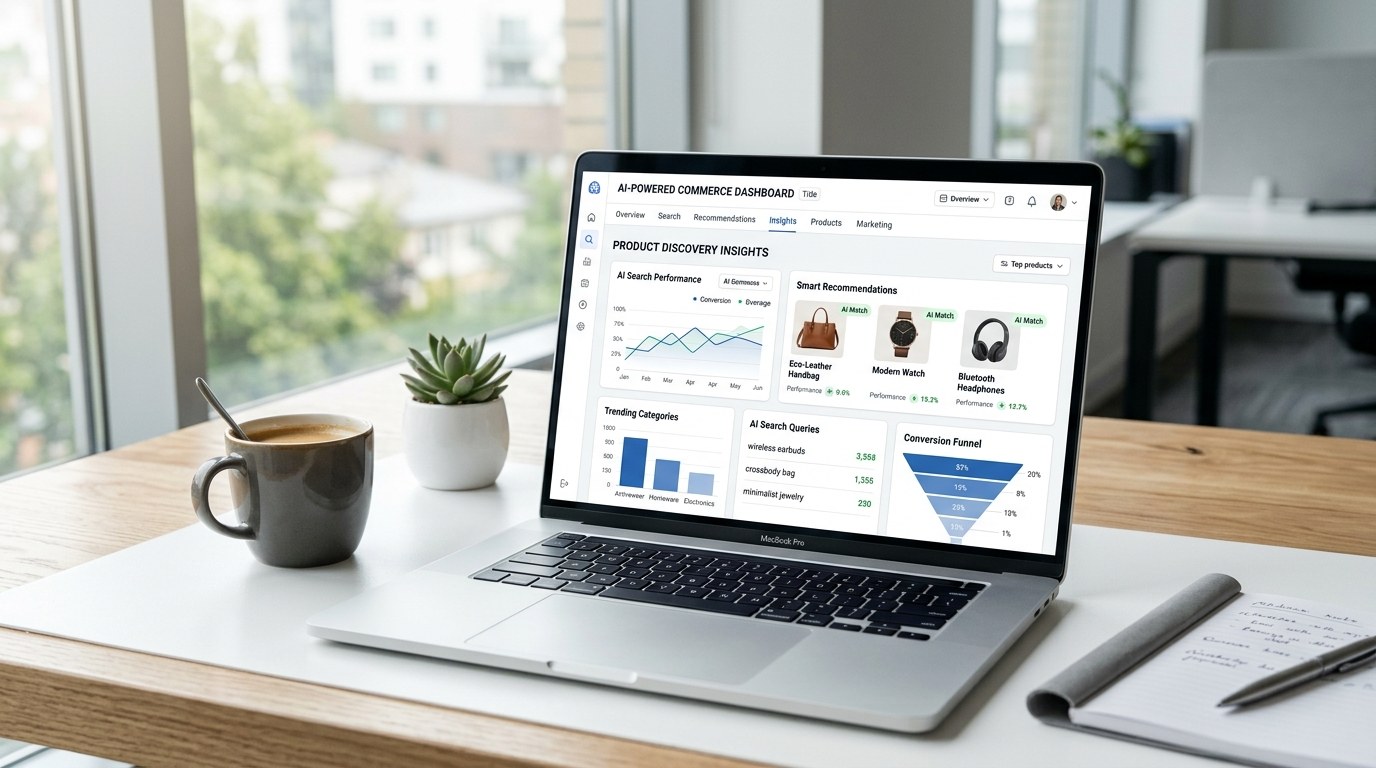
The shopify agentic storefronts guide you actually need isn't a conceptual overview — it's a tactical checklist. When a shopper asks ChatGPT to "find me a wireless keyboard under $80 with good reviews," an AI agent browses, evaluates, and adds to cart on their behalf. Whether your Shopify store gets discovered, surfaced, and purchased from in that flow depends entirely on decisions you make in your admin today.
Shopify reported that AI-referred orders tripled year-over-year in Q1 2026. Agentic Storefronts — the Shopify infrastructure that makes your store accessible to AI shopping agents — transforms that traffic channel from passive to optimized. This guide covers exactly what you need to configure, why the catalog structure matters more than most merchants realize, and what early-adopter brands are seeing in conversion rates when AI handles product discovery.
Table of Contents
- What Are Shopify Agentic Storefronts (and Why They Matter Now)
- How AI Shopping Agents Discover, Browse, and Buy on Your Store
- Setting Up Your Shopify Store for Agentic Commerce
- Catalog Structure, Metafields, and Product Data AI Agents Prefer
- Early Results: What Brands Are Seeing From AI-Assisted Shopping
- FAQ: Shopify Agentic Storefronts
TL;DR — Key Takeaways
- Shopify Agentic Storefronts use the Storefront API and structured product data to make your catalog accessible to AI shopping agents like ChatGPT, Perplexity, and Gemini
- AI-referred shoppers convert at 50% higher rates and at 14% higher AOV — this channel is worth optimizing for now
- The biggest setup gaps are missing metafields, incomplete variant data, and Storefront API permissions that are still locked down
- Structured product data (GTIN, material, size, compatibility) is the primary signal AI agents use to match products to shopper queries
- Brands preparing their catalogs now have a meaningful first-mover advantage while competitors are still treating this as theoretical
What Are Shopify Agentic Storefronts (and Why They Matter Now)
Shopify Agentic Storefronts is the infrastructure layer Shopify built in 2026 to let AI assistants interact with your store the same way a human shopper would — browse products, read descriptions, compare variants, build a cart, and initiate checkout. The difference is that the "shopper" is an AI agent acting on behalf of a real person.
The term covers a set of features working together: the Storefront API (which AI agents query for product data), the Cart API (which agents use to build and modify carts), and the Checkout Links API (which lets agents hand off a pre-built cart to the human for final confirmation). Shopify also integrated Sidekick — its AI assistant — more deeply into this flow, so merchants have a native AI agent working inside admin while external agents (ChatGPT, Perplexity, Google's AI shopping) work on the customer-facing side.
Why does this matter now, specifically? Because AI shopping referrals have crossed the threshold from negligible to material. When global e-commerce sales are projected to reach $7 trillion in 2026, even a 2–3% channel share from AI-referred orders represents hundreds of billions in GMV. More importantly for individual brands: AI-referred orders convert at higher rates and higher AOV than most paid channels, which means the economics favor prioritizing readiness above nearly everything else on your technical roadmap.
The brands that optimized for mobile in 2013–2015 captured category share that compounded for a decade. Agentic commerce readiness is the equivalent moment. The window is open now, and it won't stay open forever once competitors catch on.
How AI Shopping Agents Discover, Browse, and Buy on Your Store
Understanding how the agent flow actually works helps you prioritize what to fix first. Here's the sequence from query to cart:
Step 1: Query interpretation. A shopper asks an AI assistant something like "find me the best running shoes for wide feet under $120, available in size 11." The AI interprets this as a structured product requirement — category, attribute filter (wide width), price ceiling, and size availability.
Step 2: Store discovery. The agent queries product data sources. This includes Google Merchant Center feeds (the most common bridge between AI systems and Shopify catalogs), Shopify's own Storefront API for stores that have granted API access, and crawled product page data. Stores with clean, complete Merchant Center feeds appear in more AI queries across more platforms simultaneously.
Step 3: Product evaluation. The agent reads product attributes — not marketing copy, but structured data: material, dimensions, size range, GTIN, customer ratings, return policy, shipping time. Thin or incomplete data gets filtered out. A product description that reads well for a human shopper but lacks variant-level attributes is effectively invisible to an evaluating agent. This is the most commonly missed step by merchants doing their first agentic readiness audit.
Step 4: Cart building. Once a product is selected, the agent uses the Cart API to add it — with the correct variant (size, color, quantity). This is where incomplete variant data causes failures: if your Shopify variants don't have accurate inventory availability signals, the agent may select an out-of-stock variant and the cart breaks before the customer even sees it.
Step 5: Checkout handoff. The agent surfaces a checkout link for the human to confirm and complete payment. Shopify's Checkout Links API generates these pre-populated carts. Payment itself remains human-controlled — the agent does not charge cards.
The critical insight: AI agents are evaluating your product data, not your marketing. The catalog is the product. Everything else is secondary.
Setting Up Your Shopify Store for Agentic Commerce
There are five specific configurations that determine whether your store is accessible to AI shopping agents. These aren't optimization tweaks — they're table stakes for appearing in agentic commerce flows at all.
1. Enable Storefront API Access. Go to Settings → Apps and Sales Channels → Develop Apps. Create a Storefront API access token with read permissions for products, variants, collections, and inventory. If you're using a headless or custom storefront, this is likely already configured. Standard Shopify storefronts may have this locked down by default — verify it explicitly.
2. Connect Google Merchant Center (and keep it clean). The Shopify × Google integration pushes your product feed to Merchant Center, which is the primary data source most AI shopping agents reference. Navigate to the Google sales channel in your Shopify admin, complete the feed setup, and run a diagnostic. Fix any disapproved products — especially missing GTINs, price mismatches, and availability errors. A messy feed means AI agents see incomplete or conflicting data, and incomplete data loses to complete data every time.
3. Audit Checkout Links API permissions. In your Shopify admin, confirm that the Checkout Links API is accessible. For Shopify Plus merchants, this is enabled by default. For standard plans, verify under Apps → API credentials that the Cart and Checkout scopes are active. Without this, agents can evaluate your products but can't complete the cart handoff that closes the loop.
4. Fix variant availability signals. Every product variant needs accurate inventory tracking enabled in Shopify. If you're using "continue selling when out of stock" without a real-time inventory system behind it, you will surface out-of-stock variants to AI agents that build carts that fail. Set accurate inventory limits, or configure clear availability rules that the Storefront API can surface truthfully.
5. Verify product schema on every product page. Product schema with complete Offer blocks — price, availability, seller, GTIN — is the on-page signal AI crawlers use alongside the API. Make sure your theme outputs Product schema with Offer for every product page. Run a URL through Google's Rich Results Test to confirm. If you've done the work on ecommerce product page schema markup, you're already halfway there.
| Configuration | Where to Set It | Impact on Agentic Commerce |
|---|---|---|
| Storefront API token | Settings → Apps → Develop Apps | Enables direct AI agent product queries |
| Google Merchant Center feed | Google sales channel | Primary AI shopping data source across platforms |
| GTIN / barcode field | Products → each product | Required for cross-platform product matching |
| Variant inventory tracking | Products → each variant | Prevents out-of-stock cart failures |
| Product schema with Offer | Theme or schema app | AI crawler data completeness signal |
| Checkout Links API | Apps → API credentials | Enables cart handoff to human buyer |
Catalog Structure, Metafields, and Product Data AI Agents Prefer
This is where most merchants leave the most opportunity on the table. The Storefront API can expose your catalog to AI agents, but what agents find when they query it determines whether you win the recommendation or lose it to a better-structured competitor.
Write product descriptions for evaluation, not persuasion. Traditional product copy is written to convince. AI agents don't need convincing — they need evaluation criteria. A product description that opens with "Experience the ultimate in comfort…" gives an agent nothing useful. A description that opens with "Waterproof trail running shoe. Men's sizing 7–15 including wide (2E) and extra wide (4E). Weight: 10.2 oz. Drop: 8mm. Suitable for: packed dirt, gravel, light mud. Not designed for: technical rocky terrain." gives an agent everything it needs to match your product to the right query with confidence.
Use metafields for attributes that matter in AI shopping queries. Shopify metafields let you add structured attributes beyond the standard fields. For agentic commerce, the attributes that matter most vary by category:
- Apparel: material composition (by percentage), care instructions, fit type (slim/regular/relaxed), size system (US/EU/UK)
- Electronics: compatibility (device model, OS version), connectivity standards, battery life, dimensions and weight
- Home goods: dimensions (length × width × height), material, maximum load, assembly required (yes/no)
- Beauty: ingredients list, skin type compatibility, cruelty-free/vegan status, SPF rating
These are the attributes shoppers ask AI agents to filter by. If they're in your metafields and exposed via the Storefront API, you're matchable. If they're buried in a marketing paragraph, you're not — regardless of how compelling the copy is. Shopify's September 4, 2026 launch of native Universal Commerce Protocol (UCP) support adds a standardized discovery layer on top of this metafield infrastructure — making these attributes accessible to any UCP-compatible AI shopping agent by default.
Prioritize GTIN completeness. GTIN (Global Trade Item Number — your barcode) is the cross-platform identifier that lets AI systems match your product across data sources: your website, Google Shopping, Amazon listings, review aggregators. If your products have GTINs entered in Shopify's barcode field, AI agents can confirm your product identity, pull in third-party review data, and price-compare confidently. Without a GTIN, you're an unverified product in a world where verification equals trust.
Keep inventory data real-time. AI agents query availability at the moment of recommendation. If your Shopify inventory isn't accurate — if you're showing in-stock on a product that's actually at zero — the recommendation fails at cart. Brands using third-party inventory management need to confirm their sync frequency. A 24-hour sync is no longer adequate for agentic commerce; the operational standard is real-time or near-real-time (under 15 minutes).
Prioritize reviews. AI shopping agents weight customer rating data heavily — both score and review count. Products with fewer than 20 reviews are underrepresented in AI recommendations relative to their actual quality. Running a review generation campaign in parallel with your agentic readiness work isn't optional; it's part of the same optimization. Our post on how AI agents evaluate ecommerce products covers the ranking signals in depth.
Early Results: What Brands Are Seeing From AI-Assisted Shopping
The data on agentic commerce conversions is still early, but the directional signals are strong — and they compare favorably to most paid channels on a cost-adjusted basis.
Shopify's Q1 2026 investor report confirmed that AI-referred orders grew 3× year-over-year. Brands that had completed Merchant Center integration and Storefront API setup before the traffic spike saw significantly higher capture rates than those who hadn't. The brands caught flat-footed had the traffic arrive, bounce on incomplete product data, and leave without converting.
On conversion quality: AI-referred shoppers convert at rates approximately 50% higher than standard traffic, per Shopify's Q1 data. The AOV premium is 14%. When an AI agent recommends your product, the shopper arrives with pre-formed intent and a pre-built cart. They're not browsing — they're confirming a decision that's already been made. This is structurally different from any other traffic source.
The pattern across client accounts where we've cleaned up product data and API configuration: brands with complete metafields and accurate variant data get recommended more frequently than brands with superior products but thinner data. This rewards operational discipline over marketing spend — a meaningful shift in the economics of customer acquisition.
On catalog structure specifically: brands that add attribute metafields typically see measurable upticks in AI-referred sessions within 4–6 weeks of implementation, aligned with Merchant Center re-crawl cycles. The lift is most pronounced in competitive categories like apparel and electronics where AI agents have many options to evaluate and elimination happens fast.
One signal worth tracking on the horizon: Shopify's Sidekick integration is expanding from admin-facing to customer-facing. For a full breakdown of what the Shopify Sidekick AI assistant can do across store operations — including Sidekick Pulse and App Extensions — see our Shopify Sidekick AI guide for merchants. When merchants enable Sidekick on their storefronts, they get a native AI agent that's already perfectly calibrated to their catalog. Early merchant data shows Sidekick-assisted sessions producing AOV lifts in the 18–25% range. This is where agentic commerce goes from an external channel to a native conversion tool inside your own storefront.
Our Shopify ecommerce development team works with brands on the full agentic readiness setup — Storefront API configuration, metafield architecture, Merchant Center feed cleanup, and schema implementation. For brands evaluating custom storefront builds that expose additional catalog data to AI agents, our app development practice handles the Storefront API integration layer. And for brands that want a strategic view of how agentic commerce fits into their full acquisition mix, Atlas consulting is the right starting point.
The brands we're working with on agentic readiness right now are treating it the same way growth-focused teams treated mobile optimization in 2015: a window where early movers build durable advantages that are hard to close later. The window is open. The cost of preparation is low. The cost of waiting is not.
Frequently Asked Questions
What's the difference between Shopify Agentic Storefronts and regular Shopify SEO?
Shopify Agentic Storefronts optimization is distinct from traditional SEO in a meaningful way. Standard SEO targets Google's crawler and aims for ranking positions on the SERP. Agentic storefront optimization targets AI shopping agents — ChatGPT, Perplexity, Google's AI shopping layer, Shopify Sidekick — that query product data directly via APIs and evaluate structured attributes, not keyword-rich copy. The overlap is limited: clean product schema helps both, but metafield completeness, GTIN coverage, and Storefront API access are purely agentic concerns that most SEO playbooks don't address at all.
Do I need to be on Shopify Plus to use Agentic Storefronts?
No. The Storefront API and basic Cart API access are available on all Shopify plans. Shopify Plus merchants get additional capabilities — higher API rate limits, Checkout Links API with more customization options, and expanded Sidekick admin access — but the foundational agentic storefront setup is available to all merchants. The most impactful steps (Google Merchant Center cleanup, GTIN completeness, metafield structuring) are entirely plan-agnostic. Start them regardless of which plan you're on.
How quickly will AI shopping agents start sending traffic after I complete the setup?
Merchant Center re-crawl cycles run on a schedule that varies by store size and feed activity — typically 3–7 days for active stores with frequent price or inventory changes, longer for quieter stores. Direct Storefront API access by AI agents depends on whether those platforms have indexed your API endpoint, which varies by platform. Most brands see measurable upticks in AI-referred sessions within 4–8 weeks of completing a full agentic readiness setup. Merchant Center improvements drive results fastest; metafield improvements take slightly longer to propagate through AI recommendation systems.
Will AI agents complete purchases without the customer confirming?
No — and this is by Shopify's design. The Checkout Links API hands off a pre-built cart to the customer for final review and payment confirmation. The AI agent cannot charge a payment method or complete a transaction independently. The human remains in control of the purchase decision and payment step. This is both a consumer protection design choice and a practical reality — payment credential sharing with AI agents is not part of the current Shopify agentic architecture as of August 2026.
What if my products don't have GTINs?
Products without GTINs — typically custom, handmade, or private-label goods — can still appear in AI shopping recommendations, but they're at a disadvantage in competitive categories where most products have GTINs. For private-label brands, Shopify allows you to enter your own UPC barcode — apply for GS1 barcodes for your SKUs if you haven't already. For truly custom or artisan products, GTINs are less critical because the competitive set is also GTIN-sparse. Prioritize rich description attributes and strong review data instead — those signals carry more weight in unverified-GTIN contexts.
Ready to Make Your Shopify Store Agentic-Ready?
Our team handles the full setup — Storefront API, metafield architecture, Merchant Center cleanup, and schema — so AI shopping agents can find, evaluate, and sell your products.
Talk to Our Shopify Team