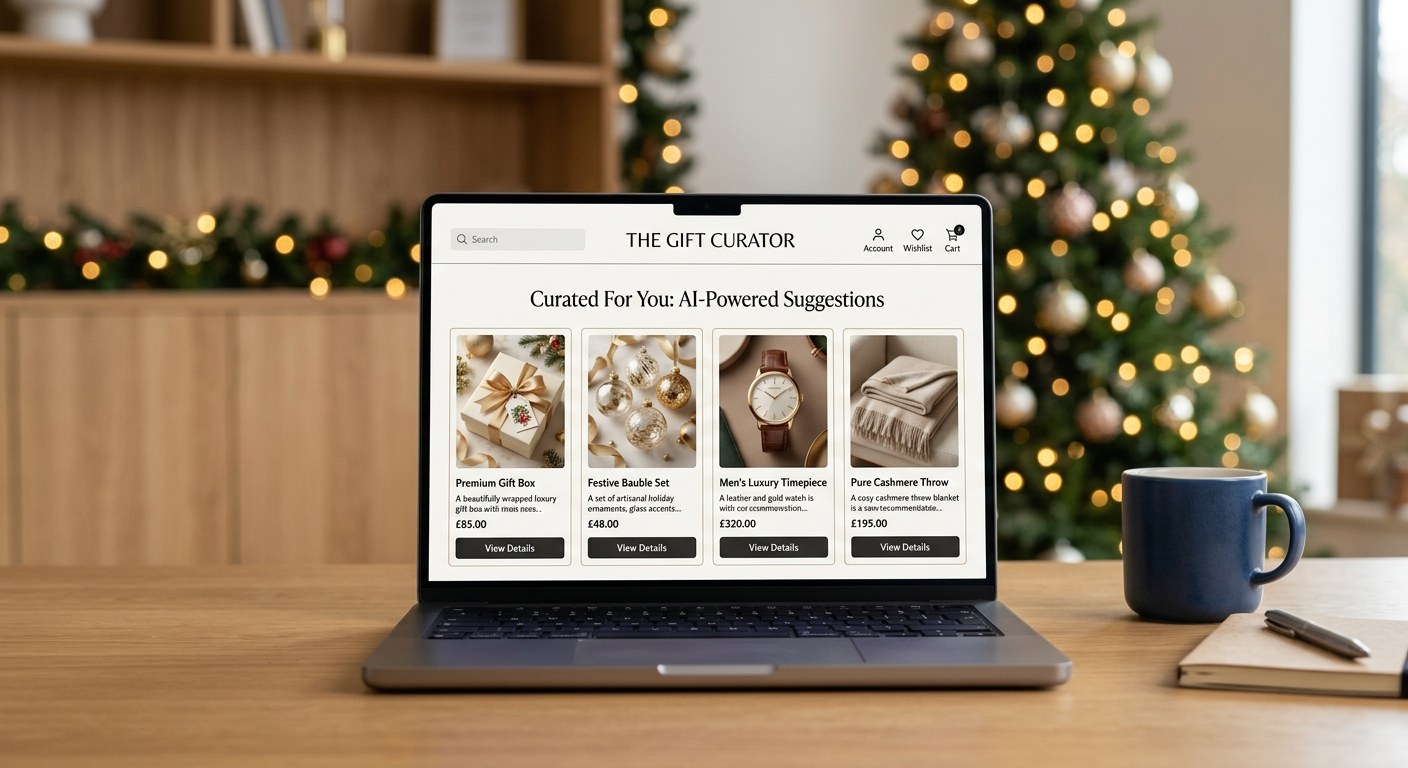
AI gift recommendations in ecommerce 2026 are no longer a nice-to-have — they're one of the highest-ROI configuration decisions a Shopify brand can make before BFCM. Ecommerce brands using AI recommendation engines see 10–30% increases in average order value, and during the holiday season, when gift-buyers land on your store with intent and budget, that lift compounds significantly.
Key Takeaways
- Gift-buyers behave fundamentally differently from self-shoppers — they need guided discovery, not browsing
- AI tools like Rebuy, LimeSpot, and Nosto can be configured specifically for gift-shopping behavior
- A well-built gift-finder experience on Shopify can increase holiday AOV by 15–30%
- Bundling logic and AI-surfaced gift sets close the gap between intent and purchase for undecided shoppers
- Set this up now — BFCM shopping behavior starts mid-October
Table of Contents
- Why Gift-Buyers Are a Different AI Personalization Target
- The Top AI Recommendation Tools for Shopify in 2026
- Configuring a Gift-Finder Experience on Your Shopify Store
- Bundling Logic: How AI Can Surface Gift Sets and Higher-Value Options
- Measuring AOV Lift from AI Gift Recommendations
- FAQ: AI Gift Recommendations for Ecommerce
Why Gift-Buyers Are a Different AI Personalization Target
Most AI recommendation systems are built around a single behavioral profile: the self-shopper. They track what you've browsed, what you've bought, and surface more of the same. That logic works well when someone is shopping for themselves — they have a clear category preference, a price point they're comfortable with, and prior behavior that signals intent.
Gift-buyers break every one of those assumptions.
A CMO buying a birthday present for her husband has zero browsing history on your site for men's products. A dad picking a holiday gift for his daughter doesn't know whether she prefers the $65 or $120 version of your skincare set. An office manager purchasing 15 client gifts before December needs quantity, variety, and giftable presentation — not a recommendation based on their own purchase history.
The opportunity here is significant. Gift-buyers are often willing to spend 20–40% more than self-shoppers on the same product category because they're optimizing for the recipient's satisfaction, not their own price sensitivity. AI-powered product recommendations account for 35% of Amazon's revenue (McKinsey, 2023) — and that number is driven substantially by gift-buying sessions where the engine successfully guides an undecided shopper to a higher-value purchase.
The problem is that a generic recommendation engine doesn't know how to reach gift-buyers. Configuring AI for gift-shopping behavior means building discovery flows that guide rather than follow — presenting options by recipient type, price band, or occasion rather than behavioral lookalikeness. Hyper-personalized recommendations are now a key expectation for 2026 ecommerce shoppers (Shopify, 2026), and gift season is where that expectation is highest.
The Top AI Recommendation Tools for Shopify in 2026
Not all recommendation engines are built equally for the gift use case. Here's how the major options compare on the attributes that matter most for Q4 personalization:
| Tool | Gift-Finder Support | Bundle Logic | Price Range Filtering | Monthly Cost |
|---|---|---|---|---|
| Rebuy | ✅ Rules-based flows | ✅ Smart bundles | ✅ Conditional rules | $99–$749 |
| LimeSpot | ✅ Collection personalization | ✅ AI bundle suggestions | ✅ Segment-based | $19–$299 |
| Nosto | ✅ Advanced segmentation | ✅ Full bundling engine | ✅ Native filters | $500+ |
| Shopify Native | ⚠️ Limited | ❌ No bundle logic | ❌ No filtering | Free |
| Visually AI | ✅ Full behavioral targeting | ✅ Dynamic bundles | ✅ Advanced | $400+ |
Rebuy is the strongest option for most mid-market Shopify brands. Its conditional logic supports gift-specific rules — "if visitor came from a gift guide landing page, show products under $75 with gift wrapping enabled." For brands doing $2M–$20M annually, Rebuy's Smart Cart and widget stack cover every touchpoint in the gift-buyer journey.
LimeSpot is the best entry-level option for brands under $2M who need AI personalization without the Rebuy price tag. Its collection-page personalization and bundle suggestions are more than capable for a focused gift-season implementation.
Nosto is the right call for enterprise Shopify Plus stores with high SKU counts and complex segmentation needs — holiday gift categories, international markets, and B2B gifting programs all require the depth Nosto provides.
Configuring a Gift-Finder Experience on Your Shopify Store
A gift-finder is a guided discovery flow that moves a visitor from "I need a gift for someone" to "add to cart" in three to five steps. It's the highest-leverage configuration change you can make to your Shopify store before the holiday season.
Step 1: Build a gift landing page. Create a dedicated /gifts or /holiday-gifts page that anchors your holiday merchandising. This page serves two purposes: it gives AI agents (Google, Perplexity) a clear semantic signal that you sell giftable products, and it gives your email and paid campaigns a high-intent destination to drive traffic to.
Step 2: Add a recipient + budget filter. Use Shopify's native metafield filtering or a quiz tool like Octane AI to let visitors answer two questions: "Who is this for?" and "What's your budget?" These two inputs transform a generic browsing session into a targeted gift discovery flow. Feed the answers into your recommendation engine as segment tags.
Step 3: Configure recommendation widgets by gift context. In Rebuy or LimeSpot, build separate widget rules for each recipient segment: "For Him Under $100," "For Her $50–$150," "Office Gift Under $50." The AI engine then surfaces products that match the rule parameters, filtered by available inventory and your chosen margin threshold. Our team at Atlas builds these configurations as part of our Shopify ecommerce optimization engagements — a well-built gift-finder typically pays for itself within the first two weeks of BFCM traffic.
Step 4: Add gift wrapping as an add-on. Every gift-finder configuration should include a gift wrapping upsell ($5–$10) that appears once a product enters the cart. This is zero-inventory overhead, adds meaningful AOV increment, and removes friction for gift-buyers who would otherwise hunt for that option elsewhere. According to Shopify's 2025 data, average order value is 30% higher during BFCM than non-holiday periods — gift wrapping is one of the easiest margin-free increments to capture during that spike.
Bundling Logic: How AI Can Surface Gift Sets and Higher-Value Options
The single most effective AOV lever for gift-buyers isn't the individual product — it's the bundle. Gift-buyers are predisposed to spend more when a pre-assembled set removes the decision work. "The Complete Skincare Set" converts faster and at higher AOV than three individually recommended products even when the bundle is priced higher.
AI recommendation engines handle bundling in two modes:
Static bundles: You define the set, the AI surfaces it to the right segments. Use this for your highest-margin gift sets where you want precise control — hero products, exclusive collections, or seasonal configurations.
Dynamic bundles: The AI analyzes purchase co-occurrence data to identify which products are most commonly bought together by gift-buyers, then assembles bundle recommendations automatically. This works well for large catalogs where manual curation isn't feasible. Ecommerce brands using AI recommendation engines see 10–30% increases in AOV (Rebuy/McKinsey, 2024) — and dynamic bundle logic is the primary driver in stores with catalogs over 200 SKUs.
Gift set tiering is the hidden AOV driver most brands miss. Configure three bundle tiers — entry ($50–$75), mid ($100–$150), premium ($200+) — and use your recommendation engine to default each visitor to the mid tier based on browsing behavior, with one-tap upgrade or downgrade options. Visitors anchored at the mid tier spend more on average than visitors shown only the entry tier.
For the full cross-sell and upsell architecture that integrates with your gift bundling strategy, our guide to Shopify cross-sell and upsell strategy for Q4 2026 covers the complete funnel — pre-cart, in-cart, and post-purchase — including how gift wrapping and bundle add-ons work inside Rebuy's Smart Cart during high-traffic periods.
Post-purchase gift add-ons close a gap most brands ignore. After an order is confirmed, surface a complementary product with a single-click add — a matching candle to go with the diffuser set, a card and ribbon bundle with the gift box. These post-purchase recommendations convert at 10–18% for gift-buyer sessions because purchase satisfaction is at its peak and the payment details are already confirmed.
Measuring AOV Lift from AI Gift Recommendations
Configuring AI gift recommendations without measurement is guesswork. Here's how to attribute the AOV lift correctly.
Segment your analytics by traffic source. Gift landing page traffic, holiday email recipients, and BFCM ad visitors should be tracked as separate cohorts in Google Analytics 4. Compare their average order values against non-holiday traffic. The delta is your baseline gift recommendation impact.
Track recommendation engagement events. Every major recommendation tool (Rebuy, LimeSpot, Nosto) fires custom events when a visitor engages with a recommendation widget — hover, click, add to cart. Set up GA4 custom events to capture these interactions and filter your AOV analysis to sessions with recommendation engagement versus sessions without. Sessions that include recommendation engagement consistently show higher AOV than sessions that don't — by a margin significant enough to justify the configuration investment.
A/B test gift-finder configurations. Most recommendation tools support native A/B testing. Run your standard recommendation widget against your gift-finder configuration starting November 1 — the 10–15 days before BFCM give you enough volume to reach statistical significance. Set your primary metric as revenue per session, not conversion rate alone, since gift-buyers often have lower conversion rates but substantially higher AOV.
Monitor bundle attachment rate. Track the percentage of holiday orders that include a bundle purchase (as opposed to individual SKUs). If your bundle attachment rate is under 15% during gift season, your bundling logic isn't surfacing the right options to the right visitors — revisit your segment rules and price tier configuration.
Our AI and automation services at Atlas include recommendation engine configuration, GA4 event tracking setup, and ongoing optimization — the full stack needed to turn AI gift recommendations from a widget into a measurable revenue layer before your BFCM traffic peaks.
FAQ: AI Gift Recommendations for Ecommerce
How much can AI gift recommendations increase holiday AOV?
Ecommerce brands using AI recommendation engines configured for gift-buying behavior see 10–30% increases in average order value during the holiday season, according to data from Rebuy and McKinsey. The lift is higher for stores with bundle configurations (typically 20–30%) than for stores using only individual product recommendations. The key variable is how well the recommendation engine is trained on gift-buyer behavior versus general self-shopper behavior — generic configurations produce smaller lifts.
Which Shopify AI recommendation tool is best for gift season?
For most Shopify brands doing $1M–$10M annually, Rebuy Engine is the strongest option for gift-season AI recommendations. Its conditional logic supports gift-specific rules, bundle configurations, and Smart Cart upsells that other tools don't match at the same price point. Brands under $1M should start with LimeSpot for its lower cost and strong bundle capabilities. Enterprise Shopify Plus merchants with complex segmentation needs should evaluate Nosto or Visually AI.
When should I set up AI gift recommendations for BFCM?
Set up your gift-finder experience and recommendation configurations before November 1. This gives your AI recommendation engine 2–3 weeks of gift-buyer behavioral data before BFCM weekend, improving the accuracy of its suggestions when traffic volume peaks. Configuration that launches November 28 has no training data — the engine is guessing, not recommending.
Do AI gift recommendations work for stores with small catalogs?
Yes, but the approach changes. With fewer than 50 SKUs, static bundle configurations outperform dynamic AI bundling because there isn't enough purchase co-occurrence data to train a meaningful dynamic model. Focus on manually curated gift sets, price-tier filtering, and recipient segmentation. The AI value in a small catalog comes from delivery timing — showing the right set to the right visitor based on their referral source or prior session behavior — rather than from recommendation diversity.
How do I track whether AI gift recommendations are generating ROI?
Configure GA4 custom events for recommendation engagement (clicks, add-to-carts from recommendation widgets) and compare revenue per session for engaged versus non-engaged visitor cohorts. Your recommendation tool's built-in dashboard will show revenue attributed directly to widget interactions. For a complete measurement setup, track bundle attachment rate, average order value by traffic source, and recommendation click-through rate as your three primary KPIs throughout the holiday season.
Ready to Configure AI Gift Recommendations Before BFCM?
Atlas's Shopify ecommerce team builds and optimizes recommendation engine setups for holiday season performance — from gift-finder UX to bundle logic to post-purchase flows.
Talk to Our Shopify Team