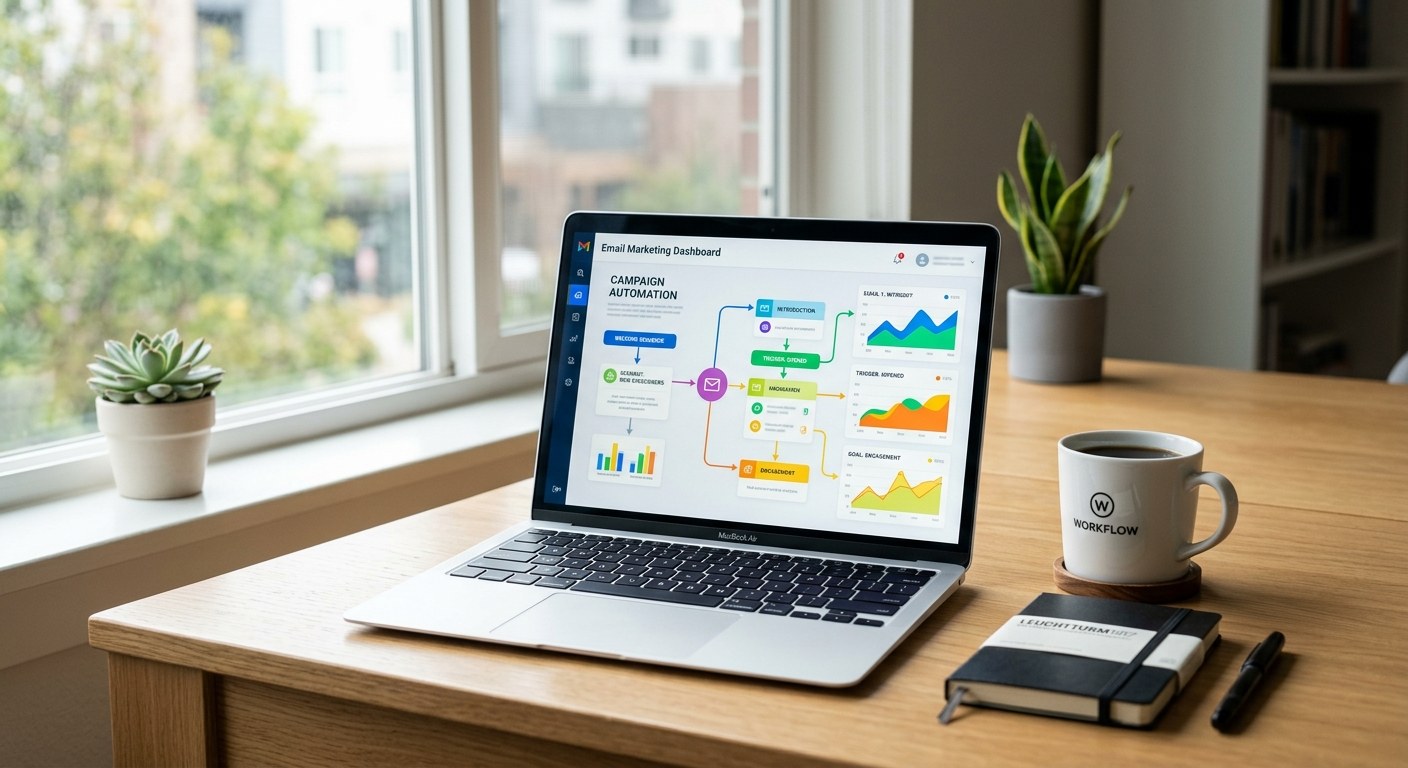
Email lifecycle sequences for ecommerce are the highest-ROI investment most brands aren't fully using. Unlike broadcast campaigns, behavior-triggered sequences fire automatically when a subscriber takes a specific action — adding to cart, completing a first purchase, going quiet for 90 days — and generate 320% more revenue per contact than generic batch-and-blast campaigns (Campaign Monitor, 2025). The brands compounding LTV fastest aren't sending more email; they're sending the right email at the exact moment behavior predicts a purchase decision.
Key Takeaways
- Behavior-triggered email lifecycle sequences outperform broadcast campaigns by 320% in revenue per contact.
- The 6 sequences that matter: welcome, browse abandonment, cart abandonment, post-purchase, win-back, and sunset.
- Welcome series is the single highest-leverage sequence — set tone and expectation before the first purchase.
- Post-purchase email timing is everything: the 72-hour window after delivery is the highest-value moment you have.
- SMS should layer on top of email, not replace it — use SMS for high-urgency recovery, not primary communication.
Why Generic Email Blasts Fail (and Lifecycle Sequences Win)
The math is simple. Retaining an existing customer costs 5–7x less than acquiring a new one (Bain & Company). Yet most ecommerce brands spend the majority of their marketing budget on acquisition, then send the same weekly newsletter to every subscriber regardless of where they are in the customer journey.
A new subscriber who hasn't bought yet needs a completely different message than a repeat buyer who hasn't ordered in four months. Sending both groups the same "20% off sitewide" campaign isn't just inefficient — it trains your list to wait for discounts and erodes margin over time.
Lifecycle sequences fix this by mapping communication to behavior. A subscriber who abandoned their cart 30 minutes ago gets a recovery email. A customer who bought three weeks ago gets a cross-sell sequence. Someone who hasn't opened an email in 120 days gets a win-back attempt — and if they don't re-engage, they get sunset before they hurt your deliverability.
This is behavior-based email segmentation in practice: your email program stops being a broadcast tower and starts being a conversation layer that responds to what your customers actually do.
The 6 Email Sequences Every Ecommerce Brand Needs
Most brands have an abandoned cart flow and maybe a welcome email. That's leaving significant revenue on the table. Here are the six sequences that form a complete lifecycle email program:
| Sequence | Trigger | Primary Goal | Typical Length |
|---|---|---|---|
| Welcome Series | Email signup (pre-purchase) | Build trust, drive first purchase | 3–5 emails, 7–10 days |
| Browse Abandonment | Viewed product, no add-to-cart | Re-engage intent | 1–2 emails, 24–48 hours |
| Cart Abandonment | Added to cart, no purchase | Recover the sale | 3 emails, 24–72 hours |
| Post-Purchase / Activation | First purchase complete | Drive second purchase, reduce returns | 4–6 emails, 30–45 days |
| Win-Back | No purchase in 90–120 days | Reactivate or confirm unsubscribe | 3–4 emails, 10–14 days |
| Sunset | No engagement in 180+ days | Clean list, preserve deliverability | 1–2 emails, then suppress |
Every sequence has a different conversion objective and requires different creative. Mapping them out as a system — rather than building them one-off — is what separates brands with flat repeat purchase rates from those compounding LTV quarter over quarter.
Welcome Series: Setting the Relationship Up for Repeat Purchases
The welcome series is the most important sequence you'll build. Open rates for welcome emails routinely hit 50–70% — five to seven times higher than any campaign you'll ever send. That's the attention window. What you do with it determines whether a new subscriber becomes a buyer, and whether a first-time buyer comes back.
The common mistake: Treating the welcome series as a discount delivery mechanism. One email, 15% off, move on. This trains subscribers to expect a coupon every time and positions your brand as a discount retailer before they've experienced your actual product.
The right structure:
- Email 1 (immediate): Brand story and positioning. Who you are, why you exist, what makes your product worth choosing. No discount yet. This sets the relationship frame before you ask for anything.
- Email 2 (day 2–3): Social proof and community. Customer reviews, user-generated content, what real buyers say. This is where trust builds — through other customers, not through your marketing copy.
- Email 3 (day 4–5): Product education. What to buy first, what goes together, how to get the most from your catalog. Make the buying decision easy.
- Email 4 (day 7–10): The offer. Now you can present the discount or free shipping threshold — but frame it as a welcome gift, not a margin concession. The brand-building work in emails 1–3 makes this land differently.
For brands with a subscription product or a strong repeat-purchase catalog (consumables, apparel, home goods), the welcome series should also set expectations around reorder timing. Plant the idea of the second purchase in the first sequence — don't wait for a separate campaign.
Post-Purchase & Activation: Turning First-Time Buyers into Loyalists
The 72 hours after delivery is the highest-value window in the customer lifecycle. Most brands miss it entirely — a shipping confirmation from ShipStation and silence until the next promotional campaign.
A structured post-purchase email sequence accomplishes three things: reduces buyer's remorse and returns, drives product adoption, and creates the conditions for a second purchase.
The post-purchase sequence structure:
- Email 1 (day 1–2 post-delivery): Product education only. How to use what they bought, tips from your team, any common setup questions answered. No discount, no cross-sell — pure value delivery.
- Email 2 (day 5–7): Social proof and community. Show them the community of buyers they've joined. User-generated content, reviews, how other customers use the product. This reinforces the purchase decision and reduces regret.
- Email 3 (day 10–14): Complementary product recommendation. Cross-sell based specifically on what they bought. This is where personalization matters — a generic "you might also like" carousel is weaker than a recommendation that says "customers who bought [X] most often pair it with [Y]." Pair this approach with interactive email formats like in-email product carousels to drive even higher click-through rates at this stage of the sequence.
- Email 4 (day 21–30): Replenishment or loyalty invite. For consumable products, this is a reorder prompt timed to typical consumption cycles. For fashion or home goods, it's a loyalty program invite or "back in stock" alert setup.
The data on this is consistent in our work at Atlas: brands with a structured post-purchase sequence see second-purchase rates 20–35% higher than those relying on broadcast campaigns alone. The sequence pays for itself in the first month.
For brands running email alongside paid social, this sequence also creates a suppression window — pull recent buyers out of your acquisition audiences for 30 days to avoid wasting retargeting spend on people who've already converted. Our team covers how to structure this across paid media and email together through our performance marketing service.
Win-Back & Reactivation: Re-Engaging Lapsed Subscribers
Every ecommerce email list has two types of subscribers: active and lapsed. Lapsed subscribers — those who haven't purchased in 90–120 days and haven't opened an email in 60+ days — aren't just a missed opportunity. They're a deliverability risk. Gmail and Yahoo's inbox placement algorithms actively penalize domains that send large volumes of email to unengaged recipients. For a full breakdown of how AI inbox ranking works in 2026, see our guide to email deliverability ecommerce 2026.
The win-back sequence serves two goals: reactivate the percentage who can still be recovered, and confirm that the rest should be suppressed.
Structure for a customer reactivation email sequence:
- Email 1 (90–120 days since last purchase): Re-engagement hook without a discount. "We noticed you haven't visited in a while — here's what's new." Show new products, recent reviews, brand updates. Some subscribers lapse simply because they forgot about you, not because they're unhappy.
- Email 2 (3–5 days later, if Email 1 unopened): A direct question. "Still interested?" Keep it short — sometimes a plain-text email with a single question outperforms a designed template because it reads as personal, not promotional.
- Email 3 (5–7 days later, if still no engagement): The offer. A discount, free shipping threshold, or exclusive product bundle. Frame it as a comeback offer — acknowledge the gap and make it easy to return.
- Email 4 (if still no engagement): Sunset notice. "We'll be removing you from our list in 7 days — confirm you'd like to stay." This generates opt-in confirmations from some percentage of subscribers who simply missed prior emails, and flags everyone else for suppression.
The customer reactivation email that works best isn't the one with the biggest discount — it's the one that arrives at the right moment with a relevant reason to come back. Brands that personalize win-back triggers by product category (sending reactivation offers for the same category a subscriber purchased from previously) consistently see higher reactivation rates than generic win-backs.
Klaviyo's Flow Analytics Dashboard makes it possible to track exactly where your win-back sequence leaks — which email in the series drives the most re-engagement, which discount threshold outperforms others, and whether reactivated subscribers have higher or lower LTV than continuously active buyers. Our Klaviyo Flow Analytics Dashboard guide covers how to read that data systematically and fix the leaks before they compound.
How to Layer SMS Into Your Lifecycle Sequences
SMS doesn't replace email in lifecycle marketing — it complements it. The channel distinction matters: email is the relationship channel (longer form, editorial, educational), while SMS is the urgency channel (cart recovery, time-sensitive offers, shipping updates). 90% of SMS messages are read within 3 minutes of receipt (CTIA, 2026). That speed makes SMS powerful for moments that expire.
Where SMS fits in lifecycle sequences:
Cart abandonment: Email at 30 minutes → check if opened within 2 hours → if not, fire SMS. This covers the non-openers without double-messaging subscribers who are already engaged. In Klaviyo, you can build this as a single flow with a conditional branch: "Has subscriber opened email? → Yes: continue email sequence → No: branch to SMS."
Browse abandonment: SMS is high-risk here. Most subscribers find an SMS about a product they briefly viewed intrusive. Reserve SMS browse abandonment for high-intent signals only — subscribers who viewed a product page three or more times, or who viewed the same item across multiple sessions.
Post-purchase: Use SMS for shipping updates and delivery notifications, not for cross-sell. SMS is trusted for transactional communication. Mixing cross-sell into your transactional SMS stream trains subscribers to treat your texts as promotional noise and accelerates opt-outs.
Win-back: SMS for win-back works only with explicit consent and careful frequency management. One win-back SMS — the "comeback offer" at the end of your email sequence — is appropriate. More than that risks opt-outs that permanently remove that subscriber from SMS communication.
The SMS platform question matters too. Brands already running Klaviyo for email are typically best served staying in Klaviyo for SMS — the unified flow builder means you can orchestrate email and text in the same sequence without managing cross-platform data sync. Our ecommerce email and SMS marketing programs are built on this unified architecture from the start, so every trigger, conditional, and suppression rule works across both channels simultaneously.
| Sequence | Email Role | SMS Role | SMS Timing |
|---|---|---|---|
| Cart Abandonment | Primary recovery (30 min) | Non-opener backup | 2h after email (if unopened) |
| Browse Abandonment | Primary (high-intent only) | High-intent only, rarely | 24h, 3+ page views only |
| Post-Purchase | Education & cross-sell | Shipping + delivery only | Transactional, same day |
| Win-Back | Full sequence (4 emails) | One offer SMS at end | Final touchpoint only |
| Welcome | Full series (3–5 emails) | None (relationship phase) | Not recommended |
FAQ: Email Lifecycle Sequences for Ecommerce
How many emails should be in a welcome series?
Three to five emails over seven to ten days is the right range for most ecommerce brands. Three emails is the minimum to build trust before asking for a purchase — one for brand story, one for social proof, one for the offer. Five emails gives you room to add product education and community-building content before the discount. More than five in the welcome window risks fatigue; your broadcast calendar takes over from there.
What's the right timing for abandoned cart emails?
The standard that holds up across most categories: first email at 30 minutes (highest recovery rate), second email at 24 hours (catches people who were interrupted or on mobile), third email at 72 hours (usually includes the incentive — free shipping or a small discount). Cart abandonment email sequences average 5–10% recovery rates on their own; combined with SMS on non-openers, recovery can reach 12–18%.
How do I know when to sunset a subscriber?
The standard threshold is 180 days without any email engagement (no opens, no clicks) combined with no purchase activity in the same window. Before sunsetting, run a one-to-two email re-permission sequence — ask them directly if they want to stay. Between 5–15% of lapsed subscribers will confirm, giving you an actively consenting, re-engaged segment. Everyone who doesn't respond gets suppressed, not deleted — you can reactivate them if they visit your site or make a purchase later.
Can I use these sequences if I'm not on Klaviyo?
Yes — the sequence logic applies to any ESP (email service provider) that supports behavioral triggers and conditional logic: Omnisend, ActiveCampaign, Drip, and others all support the core flows. Klaviyo is the dominant choice for Shopify-native brands because of its native data integrations and unified SMS handling, but the lifecycle architecture described here is platform-agnostic. The trigger logic, timing, and content strategy translate directly regardless of which tool you use to deploy it.
How long before I see ROI from lifecycle sequences?
Welcome series and abandoned cart flows typically show measurable ROI within the first 30 days of activation — you can track cart recovery directly. Post-purchase sequences show their impact at the 60–90 day mark, when second-purchase rates become visible in your cohort data. Win-back sequences should be evaluated over a full 90-day window — reactivated subscribers often have a delayed purchase cycle. Full lifecycle program ROI (all sequences running together) typically compares against a broadcast-only baseline at the 6-month mark.
Ready to Build a Lifecycle Email Program That Compounds?
Lifecycle sequences are a one-time build with compounding returns — once they're running, they generate revenue every day without additional campaign effort. The brands that set these up in year one typically see the biggest LTV advantage by year two.
Our team at Atlas builds and manages complete email and SMS lifecycle programs for ecommerce brands — from sequence architecture and copy to Klaviyo setup, segmentation logic, and ongoing performance optimization. If your email program is still primarily broadcast campaigns, our performance marketing team can scope what a full lifecycle build looks like for your brand.
See Our Email & SMS Services →