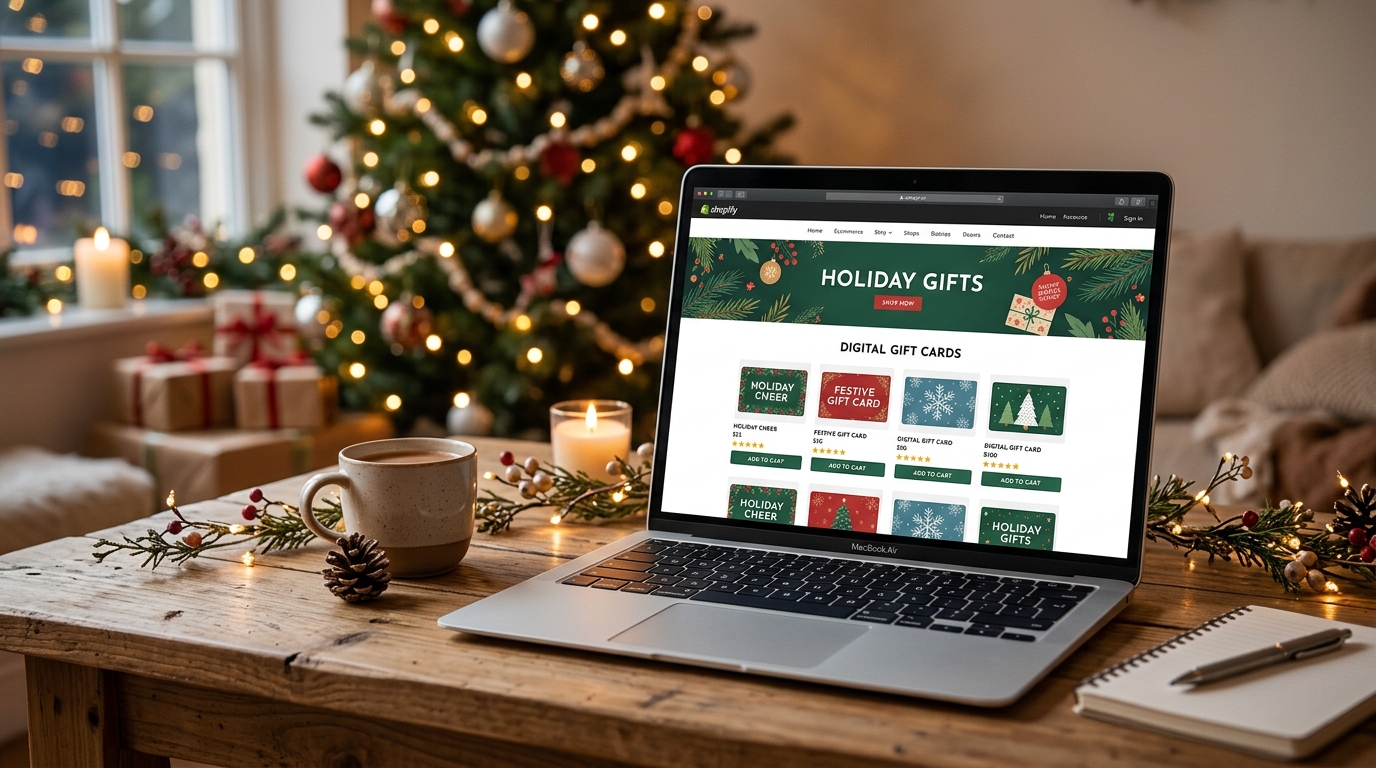
Gift cards are the #1 most requested holiday gift for the 16th consecutive year — and for Shopify merchants, they're also the highest-margin product in your catalog. Zero inventory risk, 100% margin, and when recipients redeem, they spend 20–50% more than the card's face value. Yet most stores bury their gift card product in the footer and call it done.
- Gift cards are the highest-margin Q4 product: no COGS, no inventory, no shipping
- Recipients overspend by 20–50% above face value — every redemption is a built-in upsell
- BFCM gift card promotions (e.g., buy $100 get $20 free) drive acquisition of net-new customers
- Shopify's updated Store Credit (2026) replaces the need for third-party return credit apps
- Email + SMS + paid promotion of gift cards lifts Q4 revenue without additional ad spend on new SKUs
Why Gift Cards Are Your Highest-Margin Q4 Product
Most brands chase BFCM revenue through discounts on physical inventory — cutting margin on products that cost money to make, store, and ship. Gift cards flip that equation entirely.
When a customer buys a $100 gift card, you collect $100 in cash with zero fulfillment cost. There's no picking, packing, or shipping. No product photography, no sizing issue, no return driven by a mismatch between expectation and reality. The only "product" is a digital code, and Shopify handles code generation natively.
The math gets even better at redemption. Paytronix research shows gift card recipients spend 20–50% more than the face value of the card. A $100 card typically drives a $130–$150 order. You collected $100 upfront, then sell into a customer already committed to spending — often at lower discount rates than BFCM sale prices.
Gift cards also function as a customer acquisition tool. When someone buys a gift card for a friend, that friend becomes a new customer when they redeem — often for the first time. Unlike a referral program, there's no coupon code to manage or reward to issue; the gift card itself is the acquisition mechanism.
| Metric | Physical Product (BFCM Sale) | Gift Card |
|---|---|---|
| Margin | 30–60% (discounted further 20–30%) | ~100% |
| Inventory Risk | High | None |
| Fulfillment Cost | $3–12 per order | $0 |
| Return Rate | 20–40% | Near 0% |
| New Customer Acquisition | Ad spend required | Built into the product |
| Avg. Overspend at Redemption | N/A | +20–50% above face value |
Given this profile, Shopify gift cards for BFCM 2026 deserve the same promotional energy you'd give your top SKU — not an afterthought buried in the navigation.
How to Set Up and Optimize Gift Cards on Shopify in 2026
Shopify gift cards are a native product type — no third-party app required for basic functionality. Here's how to configure them correctly.
Enable and create your gift card product: In Shopify Admin → Products → Gift Cards, create your gift card product. Set multiple denominations as variants ($25, $50, $100, $200) — buyers convert better when given options rather than a blank amount field. Add a compelling product image; don't use the default gray card icon.
Optimize the gift card product page: Your gift card PDP needs the same attention as your top SKU. Write a description that communicates the value proposition for the gift-giver: "Give them the freedom to choose exactly what they want." Include delivery information (emailed instantly, no shipping required), redemption instructions, and an expiry notice (Shopify gift cards don't expire by default in most jurisdictions, but confirm for your region).
Set denomination strategy by audience segment:
- Mass gifting budget: $25–$50 (stocking stuffer tier)
- Core gifting: $75–$100 (the most common denomination)
- Premium/VIP gifting: $150–$200 (positions your brand as a premium choice)
For BFCM, consider adding a limited-edition denomination ($150 "Holiday Edition") framed specifically as a gift — it anchors higher spend without requiring a discount on physical products.
Personalization and delivery: Shopify's native gift card emails are functional but generic. Use the theme editor to customize the gift card email template with your brand's visual identity. Add a personal message field to the product page — buyers who can include a note for the recipient convert at higher rates.
As part of our Shopify e-commerce development work, we typically rebuild the gift card product page from scratch for clients — the default setup leaves significant conversion lift on the table.
BFCM Gift Card Promotions That Drive Revenue
The most effective BFCM gift card mechanic is the bonus value promotion: buy $100, get a $20 bonus card free. This format outperforms standard percentage discounts for three reasons:
- It creates urgency without training customers to wait for discounts on physical products
- The $20 bonus card drives a return visit in January — extending the revenue tail of BFCM into Q1
- It positions the gift card as a deal, not just a convenience
Structuring the promotion:
| Purchase Amount | Bonus Card Value | Effective Discount | Redeemable |
|---|---|---|---|
| $50 | $10 | 20% | Jan 1–31 only |
| $100 | $25 | 25% | Jan 1–31 only |
| $200 | $60 | 30% | Jan 1–31 only |
Restrict the bonus card to a January redemption window. This drives post-holiday revenue and prevents immediate margin cannibalization during BFCM.
Gift card bundles: Bundle gift cards with low-cost physical items to increase perceived value. A $100 gift card + branded tote + handwritten note card, packaged and shipped as a "gift box," adds a physical dimension to an otherwise digital product. It also creates a social media-worthy unboxing moment.
Corporate and bulk gifting: Most Shopify stores ignore the B2B gift card opportunity entirely. Add a "Corporate Gifting" section to your gift card page with volume pricing (e.g., 10× $100 cards for $950) and a contact form. During BFCM, companies actively purchase bulk gift cards for employee gifts and client appreciation. Our Shopify e-commerce team frequently sets up simple B2B request flows for exactly this use case.
Using Shopify Store Credit to Retain Post-Return Customers
Shopify's Store Credit feature, significantly updated in 2026, now allows merchants to issue, manage, and track customer credit natively — without a third-party loyalty or returns app. (Shopify, 2026)
This is particularly valuable during BFCM. Holiday purchases have the highest return rates of the year (apparel can hit 40%+), and cash refunds are the most expensive outcome: you lose the sale AND the customer often doesn't come back. Store credit converts that loss into a retained customer.
How to use Store Credit for BFCM returns: Offer a store credit incentive for customers who choose credit over cash refund — e.g., "$100 store credit vs. $90 cash refund." The 10% uplift costs you nothing but margin on a theoretical future purchase, and it converts a return into a revenue opportunity.
The 2026 Shopify Store Credit update allows credit to be issued directly from the Order admin screen, tracked per customer, and applied automatically at checkout — no additional app required. Unlike gift cards, store credit is customer-specific (non-transferable), which reduces abuse.
Store Credit vs. Gift Cards: When to Use Each:
| Use Case | Gift Card | Store Credit |
|---|---|---|
| Selling as a product | ✅ Yes | ❌ No |
| Post-return retention | ❌ Awkward | ✅ Ideal |
| New customer acquisition | ✅ Yes (gifting) | ❌ No |
| Loyalty rewards | Possible | ✅ Better fit |
| Transferable | ✅ Yes | ❌ No |
We've built Store Credit + return flow integrations for several clients as part of broader Shopify BFCM prep checklists — it's a high-leverage setup that takes less than a day to configure correctly.
Promoting Gift Cards Through Email, SMS, and Paid Ads
Gift cards are undersold because brands don't promote them the same way they promote physical products. Fix that with dedicated gift card campaigns across every channel.
Email marketing: Send a standalone gift card email at three key moments: the week before BFCM (gift idea seed), Black Friday (the sale), and December 15–20 (last-minute gift with instant delivery). The last-minute angle is powerful — a gift card is the only product that can be purchased at 11 PM on December 24 and arrive on time.
Use subject lines like "The gift that never misses (and arrives instantly)" rather than generic sale language. Segment your list: send higher-denomination CTAs ($150–$200) to your VIP/high-LTV segment, and entry-level denominations ($25–$50) to your full list.
For clients running Klaviyo flows for DTC automation, we add a dedicated gift card flow triggered by seasonal tags — this runs without manual campaign effort every Q4.
SMS: Gift cards are a natural SMS product: high intent, instant delivery, low consideration time. Send a 2–3 message sequence: BFCM launch announcement, mid-week reminder, and a "last chance" before Cyber Monday ends. Include a direct link to the gift card PDP — SMS recipients don't browse, they click and buy.
Paid advertising: Create a dedicated gift card ad set separate from your product campaigns. The creative angle is "no wrong size, no wrong color, ships instantly" — it directly addresses the friction that makes physical gifting stressful. Run this on Meta (especially Instagram Stories) with a simple lifestyle image.
Target gift-buyers separately: use Meta's gift-intention behavioral targeting and remarketing to cart abandoners with a gift card alternative message ("Not sure what size? Send them a gift card instead"). Gift cards are the #1 most requested holiday gift for the 16th consecutive year (NRF, 2024) — lean into that in your ad copy.
FAQ: Shopify Gift Cards for BFCM
Do Shopify gift cards expire?
By default, Shopify gift cards do not expire. However, expiry rules vary by jurisdiction — some US states have laws against gift card expiry, while others allow it after a set period. Check your local regulations before setting any expiry. For BFCM-specific bonus cards, you can restrict redemption windows using Shopify discount codes tied to the bonus offer rather than the gift card itself.
Can I run a "buy $X get $Y free" gift card promotion natively in Shopify?
Shopify doesn't have a native "buy gift card, get bonus gift card" discount type. The most reliable implementation is to use Shopify Scripts (available on Shopify Plus) or a third-party app like Gift Wizard or GiftKart to issue the bonus card automatically at checkout. On standard plans, you can handle it manually for lower volume, or use a discount code as the bonus mechanism. Our Shopify development team can set this up cleanly if you're on Plus.
How does Shopify Store Credit differ from gift cards?
Store Credit is customer-specific and non-transferable — it lives on a customer account, not a code. Gift cards are transferable codes that can be used by anyone. Store Credit is better for post-return retention and loyalty rewards; gift cards are better for gifting and sale as a product. Shopify's 2026 update makes Store Credit a first-party feature requiring no additional apps.
What denominations should I offer for BFCM gift cards?
Offer at least three tiers: $50 (entry), $100 (core), and $150–200 (premium). Research consistently shows that $100 is the most purchased gift card denomination. Adding a $200 option raises the perceived anchor and often lifts the average purchase to $100–$150. Avoid open-ended amount fields unless your product pricing varies significantly.
How do I track gift card revenue separately in Shopify Analytics?
Gift card sales appear in Shopify Analytics under Sales → Gift Cards. You can view outstanding gift card liability (sold but not yet redeemed) and redemption data. For more detailed attribution — which campaigns drove gift card purchases, and which redeemed orders were sourced from gift cards — use Shopify's built-in UTM tracking on the PDP link and filter orders by payment method "Gift Card" in your reports.
Gift cards aren't a passive revenue stream — they're an active Q4 strategy. The brands that treat them as a flagship BFCM product, promote them deliberately, and pair them with smart Store Credit mechanics on the returns side will capture revenue that their competitors leave on the table.
If you want help setting up gift card product pages, bonus value promotions, or Store Credit return flows on Shopify, our e-commerce team works with brands through exactly this kind of Q4 optimization. Reach out before BFCM — there's still time to do it right.