AI Product Photography for Ecommerce Brands 2026
AI product photography tools can cut studio costs by 80% in 2026. Here's which tools work for fashion, home goods, and accessories — and what they can't replace.
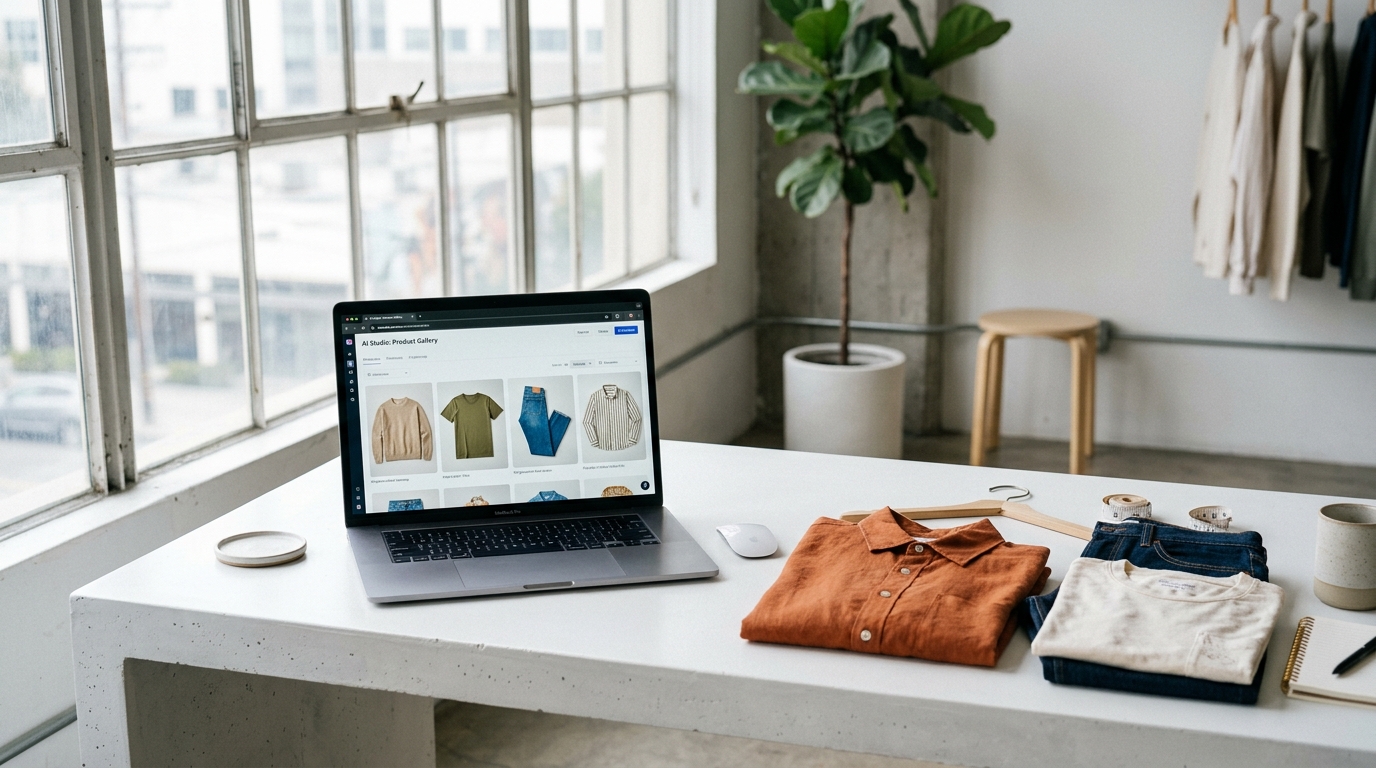
AI product photography for ecommerce has crossed a threshold in 2026 — tools like WearView can now generate on-model imagery and ghost mannequin shots from flat-lay uploads in minutes, cutting studio costs by up to 80% for fashion and apparel brands. The workflow shift is real and measurable. But not every category benefits equally, and getting the implementation wrong — misrepresenting product color, texture, or fit — drives returns up rather than revenue.
Key Takeaways
- WearView and comparable AI photo tools can reduce listing creation costs 60–80% for flat-product categories
- Fashion and accessories see the highest ROI; furniture and high-texture products carry the highest misrepresentation risk
- Ghost mannequin shots and lifestyle composites are AI-ready; detail/texture crops and scale reference shots still need human oversight
- AI photography that misrepresents product appearance is a returns liability, not a cost savings
- Best practice: hybrid workflow — AI for volume, human production for hero shots and high-ticket SKUs
Table of Contents
What AI Product Photography Can (and Can't) Do in 2026
The honest version of what AI product photography delivers in 2026 is narrower than the marketing suggests — but where it works, it works exceptionally well.
What AI handles well:
- White-background hero shots from raw product uploads
- Ghost mannequin / invisible-mannequin shots for apparel
- Background replacement and lifestyle scene compositing
- On-model imagery for fashion (flat-lay input → styled model output)
- Color variant generation from a single base image
- Bulk processing — hundreds of SKUs in parallel
What AI still struggles with:
- Accurate texture rendering — velvet, leather, knit, and rough surfaces lose fidelity
- Scale — AI composites often distort the apparent size of the product relative to scene elements
- Detail macro shots — stitching, zippers, hardware, grain patterns
- Reflective surfaces — watches, glassware, jewelry with complex facets
- Packaging-heavy products where label copy must be legible
The dividing line is fidelity to physical reality. AI excels at scene and context; it still loses resolution on material specificity. For brands where texture, material, and scale are core to the purchase decision — furniture, high-end apparel, beauty tools, artisan goods — AI photography requires more human QA investment than it saves.
For brands selling simpler product silhouettes — basics, accessories, home décor with clean lines — AI photography is already production-ready. Product image quality remains a top-3 conversion factor on ecommerce product pages (multiple CRO studies), which means the quality threshold for AI output has to match studio photography, not sit below it.
Best AI Product Photo Tools by Category
| Tool | Best For | Strengths | Limitations | Starting Price |
|---|---|---|---|---|
| WearView | Fashion, apparel, accessories | On-model generation, ghost mannequin, video clips from flat-lay | Texture accuracy on heavy fabrics | Custom / enterprise |
| Pebblely | Home goods, lifestyle products | Background replacement, scene compositing, batch processing | Scale consistency in scenes | From $19/mo |
| Caspa | Beauty, skincare, packaged goods | Product-in-scene compositing, color accuracy | Limited model generation | From $29/mo |
| Photoroom | All categories | Background removal, shadow generation, simple compositing | Not a full production replacement | Free–$29/mo |
| Flair.ai | Accessories, apparel, CPG | Lifestyle scene generation, brand-style presets | Less control over fine detail | From $25/mo |
| StudioShot | Electronics, hardware | Clean product isolation, reflection handling | Limited lifestyle capability | From $39/mo |
Fashion and apparel: AI wins for volume production. WearView's on-model generation is the most significant capability shift in fashion ecommerce creative in years. Brands producing 50+ new SKUs per season can eliminate multiple studio days. AI content and creative automation tools represent one of the fastest-growing segments in ecommerce tech investment in 2026 (rewarx.com), and fashion is leading adoption.
Beauty and skincare: Strong for packaged products. AI backgrounds and scene compositing work well for bottles, jars, and boxes. Formulation-result photography — skin before/after, product texture on skin — still requires human production.
Home goods and furniture: Mixed results. Simple decor, textiles, and accessories work well in AI scenes. Large furniture pieces often lose accurate scale references, which directly affects buyer confidence and increases returns.
Accessories (bags, jewelry, sunglasses): AI performs well for lifestyle compositing. Jewelry requires human photography for detail accuracy — AI still blurs fine chain links, pavé settings, and surface finishes.
Electronics and hardware: Good for isolation shots; lifestyle compositing is improving. Not a replacement for functional/context photography where product interfaces must be visible and legible.
WearView Deep Dive — From Flat Lay to On-Model in Minutes
WearView is the most disruptive AI product photography tool for fashion brands in 2026. Its core capability: take a flat-lay product image and generate on-model lifestyle photography, ghost mannequin shots, and short-form video clips without a physical model, photographer, or studio. WearView generates on-model imagery, ghost mannequin shots, and short-form videos from flat-lay uploads, significantly reducing listing creation time for fashion brands (ayautomate.com / aliapopups.com 2026).
The actual workflow:
- Upload flat-lay or hanger image of garment (minimum 1000px, clean white or neutral background)
- Select model parameters: body type, skin tone, styling context (casual, editorial, athletic)
- Select scene context: urban, studio, interior, outdoor
- Generate — typically under 90 seconds per image
- Review output and flag variants for production or re-generation
For a 200-SKU catalog that previously required two studio days and a model day to shoot, WearView's workflow reduces listing creation time from weeks to hours. A mid-size studio day with model, photographer, stylist, and editor runs $3,000–$8,000. WearView produces equivalent volume for a fraction of that at scale.
WearView also generates short-form video clips — 3–5 second product reveal animations suitable for PDPs, social ads, and email headers. These aren't TikTok UGC replacements, but they're solid supplementary assets for brands without a video production budget. If you're evaluating whether AI or real creator content is the right call for your ad creative, the UGC vs. AI creative guide for ecommerce ads covers when each format wins and why. And if you're moving forward with real creator content, the UGC creator brief template ensures your production brief gets ad-ready footage on the first delivery.
What to watch for in WearView output:
- Drape and hang accuracy: AI models tend to show garments fitting more ideally than reality. For fitted styles, this is a returns risk. For oversized or relaxed cuts, less of an issue.
- Ethnic and body type diversity: The model generator has improved substantially in 2026, but always audit output for representation consistency across your catalog.
- Fabric texture: Heavier materials — denim, corduroy, leather — lose texture fidelity at smaller image sizes. Always zoom-check outputs before publishing.
When AI Photography Hurts Conversions (The Returns Problem)
AI-generated imagery that misrepresents a product's appearance is not a cost savings — it's a returns liability. Returns in ecommerce average 20–30% across categories, with fashion at 30–40%. The number-one stated reason: "Product didn't match what I expected from the photos." AI photography, deployed without proper QA, makes this problem worse.
Color accuracy: AI compositing frequently shifts color temperatures depending on scene lighting. A navy garment photographed on a warm-toned lifestyle background can appear nearly black or slightly purple. Always color-calibrate AI outputs against physical product reference shots before publishing.
Scale distortion: AI scene compositing doesn't always respect real-world scale relationships. A small vase can appear dramatically larger or smaller than reality depending on how the AI places it in a lifestyle scene. This is particularly damaging for home goods and furniture, where sizing is a core purchase consideration.
Texture misrepresentation: AI-generated product images tend to "smooth" surfaces. A cashmere sweater may look like fine cotton. A rough-hewn ceramic may look glazed. Any product where texture is a key value proposition requires human photography to avoid systematic misrepresentation.
Fit and proportion: WearView and other on-model generators show garments at idealized fit. If your product is designed to be oversized, boxy, or has intentional draping, verify that AI model outputs match the intended wearing experience — not an optimistic approximation of it.
The QA checkpoint: every AI-generated image should be reviewed against a physical product reference before it goes live. Our team at Atlas Creative & Content builds this checkpoint into every AI creative workflow we deploy for ecommerce clients — it's the step that separates responsible AI photography implementation from return spikes and brand trust erosion.
Building a Hybrid Studio Workflow — AI + Human for Maximum Output
The most effective AI photography approach isn't "AI instead of studios." It's "AI for volume, humans for hero shots and high-risk SKUs." The brands getting the best ROI from AI product photography in 2026 treat it as a tiered production system, not a single-tool replacement.
Tier 1 — AI-only (80% of SKUs):
- Color variants of proven styles
- Repeat-structure SKUs (same silhouette, different colorway/print)
- Secondary catalog images (scene composites, additional angles)
- Seasonal lifestyle context updates (same product, new background)
Tier 2 — AI primary + human QA (15% of SKUs):
- New style introductions where fit and proportion must be validated
- High-price-point items where a returns-driven bad review is costly
- Products with complex textures or functional details that need verification
Tier 3 — Human studio primary (5% of SKUs):
- Campaign hero shots (brand-defining imagery)
- Products where tactile quality is the primary value proposition
- Jewelry, watches, high-end leather goods, artisan ceramics
- Any product where legal accuracy claims depend on visual representation
| Scenario | Traditional Studio | AI-Assisted Hybrid | Est. Savings |
|---|---|---|---|
| 100 SKU launch (white background) | $4,000–$8,000 | $300–$800 | ~85–90% |
| 100 SKU launch (lifestyle) | $12,000–$25,000 | $1,500–$3,500 | ~75–85% |
| 500 SKU catalog refresh | $40,000–$80,000 | $5,000–$12,000 | ~80–90% |
| Single campaign hero shot | $3,000–$6,000 | $3,000–$6,000 | Minimal advantage |
The savings compound at scale. The ROI case for AI photography is weakest for one-time hero shots and strongest for high-SKU-volume catalog maintenance — the exact inverse of where most brands initially focus their attention.
For brands rebuilding their Shopify ecommerce product pages around conversion optimization, photography workflow decisions intersect directly with PDP architecture — image sequence logic, mobile-first display, and load performance all affect how AI-generated assets need to be formatted and delivered. Getting the creative production pipeline right before investing in AI tooling prevents the most common implementation mistakes.
FAQ
Is AI product photography good enough to replace studio photography entirely?
For most high-SKU ecommerce brands, AI handles 70–80% of photography needs cost-effectively in 2026 — particularly white-background hero shots, color variants, and lifestyle composites for apparel and simple product categories. It does not replace studio photography for campaign hero shots, high-end jewelry and accessories, or any product where texture, scale, and material fidelity are central to the purchase decision. The most effective approach is a tiered hybrid workflow, not a wholesale replacement.
Which product categories benefit most from AI product photography?
Fashion basics and apparel (especially through WearView's on-model generation), simple home décor, packaged beauty products, and accessories with clean silhouettes see the highest ROI from AI photography tools. Categories with the lowest benefit — and highest misrepresentation risk — include fine jewelry, high-texture materials (leather, knit, velvet), furniture, and any product where size reference accuracy affects buyer confidence.
What is WearView and how does it work?
WearView is an AI product photography platform that generates on-model imagery, ghost mannequin shots, and short video clips from flat-lay product uploads. Fashion brands photograph garments flat on a neutral background, upload them to WearView, and the platform generates styled, on-model images in under 90 seconds. It significantly reduces listing creation time for apparel brands with large SKU catalogs. WearView supports body type and styling customization, and its output quality has improved substantially in 2026 — though texture fidelity on heavy fabrics still requires human QA before publishing.
How do I prevent AI product photography from increasing my return rate?
The primary return risk with AI photography is misrepresentation — color shifts from scene lighting, texture smoothing, and scale distortion. Mitigate these by always reviewing AI outputs against physical product reference samples before publishing; including at least one unedited flat-lay or detail crop shot on every PDP alongside AI-generated imagery; and using AI primarily for scene composites and lifestyle context, not as the sole color and texture reference. Building a QA checkpoint into your AI photography workflow is non-negotiable for any brand where returns are a material cost.
What does AI product photography cost vs. traditional studio?
A traditional studio day for a 100-SKU catalog (white background) typically runs $4,000–$8,000 with model, photographer, stylist, and post-production. AI-assisted production for the same catalog runs $300–$800 — a 75–90% cost reduction at that volume. For lifestyle compositing, traditional studio runs $12,000–$25,000 for 100 SKUs; AI-assisted hybrid runs $1,500–$3,500. The savings are largest for catalog maintenance and variant production; hero campaign shots see minimal AI cost benefit because the production quality requirements necessitate human direction and expertise regardless of tool.
Ready to build an AI-assisted creative production workflow for your brand? Atlas's Creative & Content practice designs and implements photography and creative workflows for ecommerce brands — from AI tool selection and flat-lay production standards to hybrid QA processes that protect conversion rates. Start a conversation.